
Hagar: Group-wide data infrastructure for Iceland’s most complex retail group
How one of Iceland’s largest and most diversified companies turned fragmented operational data into a trusted, group-wide foundation, and why that precision compounds year after year.
10 businesses. 100+ locations. 3,500+ employees.
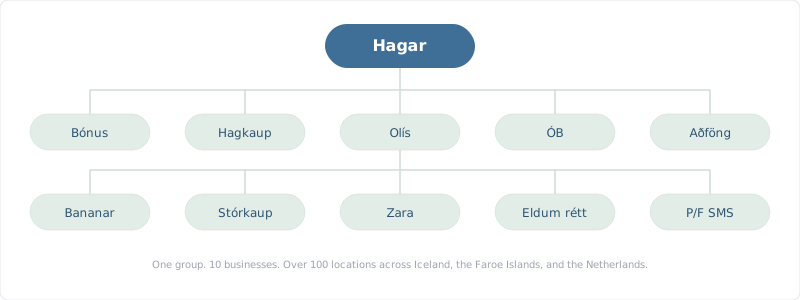
Hagar is not a single company. It is a family of businesses, Bónus, Hagkaup, Olís, ÓB, Aðföng, Bananar, Stórkaup, Zara, Eldum rétt, and most recently P/F SMS in the Faroe Islands. Over 100 locations. More than 3,500 employees of 60 nationalities. Operations spanning Iceland, the Faroe Islands and the Netherlands. A supply chain that stretches from banana plantations in Central America to fuel terminals in the North Atlantic.
Managing one of these businesses well is hard. Managing all of them, and understanding their collective operational footprint with enough precision to satisfy investors, meet regulatory expectations and benchmark progress year over year, requires something most companies do not have: a single, reliable source of truth across the entire group.
Klappir provides that infrastructure for Hagar.
Complexity without a shared structure
Retail at the scale and diversity of Hagar generates data from hundreds of sources simultaneously. Energy meters across 100-plus stores, warehouses and fuel stations. Refrigeration systems across multiple brands. Vehicle fleets serving different distribution models. Food waste flows from perishable supply chains. Air, sea and road freight crossing multiple borders.
The problem isn’t the volume of data. It’s that data from 100-plus locations with different operating models has no shared structure, so it can’t be compared, verified or trusted.
Managing this in spreadsheets, collating invoices from dozens of service providers, reconciling figures across subsidiaries, it doesn’t just create inefficiency. It produces data that cannot be trusted, targets that cannot be tracked, and reports that cannot be assured.
One platform for the whole group
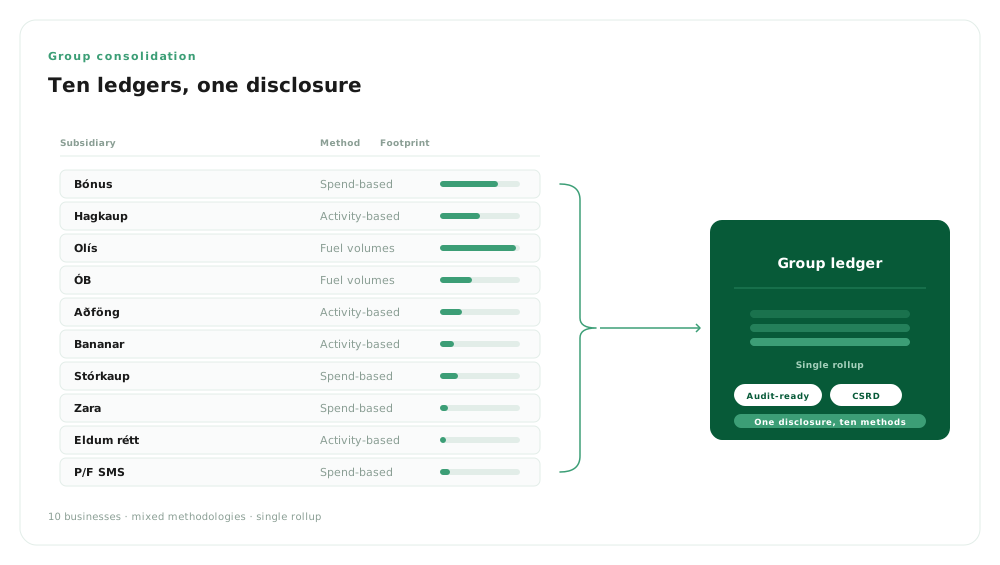
Hagar has used Klappir’s Sustainability Platform as the operational backbone of its group-wide data accounting since 2018. All GHG emissions calculations across the full Hagar group, Scope 1, 2 and 3, are managed through the platform, in accordance with the Greenhouse Gas Protocol.
This is not a reporting layer placed on top of existing systems. It is the GHG accounting system itself.
Data flows in from service providers, where emissions factors are applied, scope boundaries are maintained, year-on-year comparisons are produced, and the audit trail is maintained. When Hagar's independent auditors provided limited assurance on the group's GHG figures, energy data and workforce metrics in 2025, that assurance rested on the quality and traceability of the data held in Klappir.
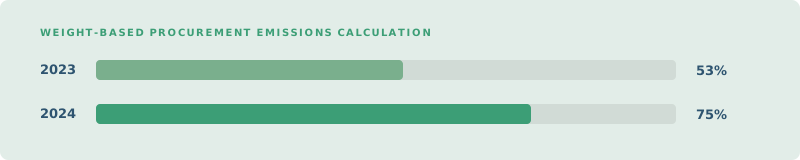
The standardised data foundation also enables expanding the scope and precision of measurement year over year. In 2025, 77% of Hagar's procurement emissions were calculated using a weight-based methodology, up from 53% in 2023. That shift only becomes possible when the underlying data infrastructure can support it. End-of-life emissions from sold food products were added to the GHG inventory for the first time in 2024. Each year, the picture gets more complete.
The results
Precision that compounds
Emissions
Total group GHG emissions in 2024
Freight & Supply Chain
Reduction in air freight emissions since 2022
Waste
Reduction in disposal volumes (1,516t in 2023 → 563t in 2025)
Location-Level Visibility
In recognition of the quality of its disclosure, Hagar was named among the top Icelandic companies in PwC's Sustainability Index in 2025, noted specifically for the accuracy and ambition of its reporting as well as emissions reduction.
“Hagar has been using Klappir’s Sustainability Platform since 2018 with great results. The platform enables us to gather and process the information we need to populate our sustainability report in a secure and simple way, and furthermore, the platform is the basis for us to set measurable goals when it comes to environmental and social parameters.”

Infrastructure that scales with the business
The data infrastructure scales with the business. Each expansion in scope, new subsidiaries, more precise methodologies, additional emissions categories, becomes possible because the foundation is already in place.
Hagar has set a target of at least 60% reduction in Scope 1 and 2 emissions by 2030. That target was set with confidence because the baseline is audited and the trend is tracked. That’s what the platform is built to provide.
Common questions
What teams most often ask about this story.
Yes. All GHG emissions calculations across the full Hagar group are managed through Klappir, in accordance with the Greenhouse Gas Protocol. When Hagar’s independent auditors provided limited assurance on the group’s GHG figures in 2024, that assurance rested on the quality and traceability of data held in the platform.
Sorting ratios are tracked per location so individual store managers can see how their location performs relative to comparable assets. Disposal volumes fell from 1,516 tonnes in 2023 to 350 tonnes in 2024 as visibility into waste streams enabled targeted operational improvements.
Data flows in from service providers across all subsidiaries. Each expansion, new subsidiaries, more precise methodologies, additional emissions categories, becomes possible because the foundation is already in place. In 2024, 75% of procurement emissions were calculated using weight-based methodology, up from 53% in 2023.
Have a different question?
Talk to our team about your organisation’s data infrastructure.
Ready to see what your resource data can do?
See how resource data infrastructure fits your organisation in a 30-minute walkthrough. We’ll look at your current data landscape and show you how a continuous foundation replaces the annual rebuild.
No commitment. No sales deck. Just a conversation about your data.