
Húsasmiðjan: From store floors to supply chains, the full picture.
How Iceland’s largest building materials chain built the data infrastructure to account for its entire operational footprint, and the supply chain behind it.
14 stores. Three brands. One data foundation.
Húsasmiðjan is the oldest and largest hardware and home improvement chain in Iceland, founded in 1956. Operating 14 hardware stores nationwide, seven Blómaval garden centres, and four Ískraft trade outlets. Together the three brands supply both the construction industry and Icelandic households, which makes Húsasmiðjan a primary route through which building materials reach projects across the country.
The company has used the Klappir Platform as the accounting system for all ESG data across its combined operations since 2019.
Husasmidjan is part of Bygma Group, the family-owned building materials group active across Northern and Central Europe, with more than 125 business units, around 3,000 employees and record revenue of DKK 11.6 billion in 2025.
A footprint that reaches far beyond the shop floor
Húsasmiðjan's responsibility for resource data does not stop at its own stores. As Iceland's largest supplier of building materials, the company sits at the centre of a supply chain that delivers products to building projects nationwide, and the data behind that flow is harder to see than the energy and waste at a single site.
Accounting for that picture across fourteen stores, three brands and a network of suppliers needs more than a year-end reporting exercise. Húsasmiðjan needed a system that pulls data automatically from service providers, consolidates it in one place, and puts performance data in front of the people who run each location, not only the specialists who compile the statement.
One platform. Every location. An expanding view of the supply chain.
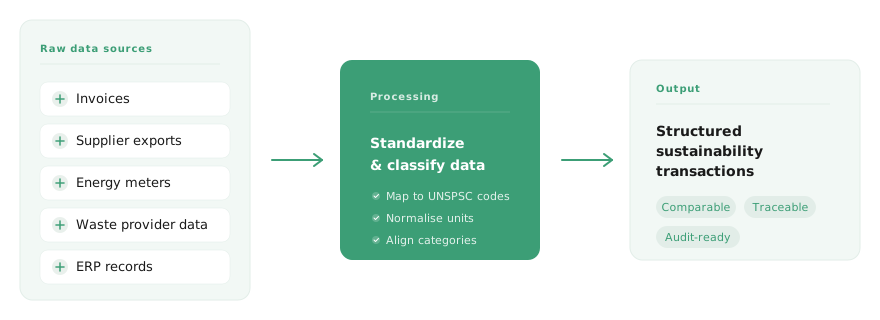
Húsasmiðjan uses the Klappir Platform as the accounting backbone for ESG data across Húsasmiðjan, Blómaval, and Ískraft. Data flows automatically from service providers into the platform, covering energy, fuel, heating, water, and waste across all locations. Emissions are calculated under the GHG Protocol across Scope 1, Scope 2, and an expanding set of Scope 3 categories, and the data underlying the annual statement is reviewed and assessed by Klappir's sustainability specialists.
Store managers have direct access to their own performance data within the system, enabling a good overview across the network and putting resource decisions closer to where the work happens.
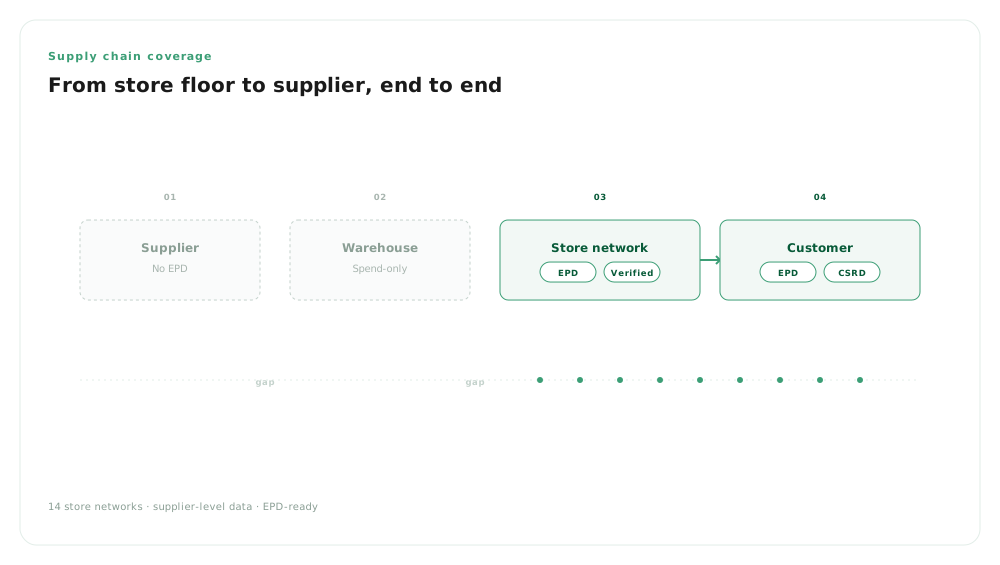
In 2024 Húsasmiðjan extended its accounting into the supply chain, capturing upstream transport and the embedded emissions in purchased construction materials, including steel, wood and gypsum, as well as shipping emissions from freight partners such as Samskip and Eimskip. Steel is accounted for using emission factors from environmental product declarations for the most common steel types, while wood and gypsum are accounted for using database factors. What was previously invisible is now measured and reported.
Each new data category is not a sign of a growing footprint. It is a sign of a maturing data operation, with more of the real picture brought inside the same governed foundation.
Measurable results
Progress that holds up under scrutiny
Emissions
Reduction in Scope 1+2 emissions (2022–2025)
Waste
Reduction in waste to landfill 2023-2025
Energy
Renewable energy share in 2024
Supply Chain
Total measured footprint in 2025, including Scope 3
First Icelandic building materials chain to hold both FSC and PEFC timber certification, audited by DNV, ensuring traceability from forest to customer.
“The social and environmental policy is one of Húsasmiðjan’s core policies. We take good care of our people, the environment and the future, which all go hand in hand with operating profits. We are constantly looking for ways to save energy, reduce waste and work in the greatest possible harmony with the company’s environment. Húsasmiðjan has, for several years, collaborated with Klappir on measuring the energy consumption of operations and waste disposal at establishments. The Klappir Platform collects real-time data directly from our service providers and calculates the operation’s carbon footprint. And on a happy note, Húsasmiðjan has improved in most of these aspects since measurements began.”

A data operation that keeps expanding its reach
Húsasmiðjan has set a target of reducing total carbon emissions by 40% by 2030, with sorted waste reaching 90% by 2025. Scope 3 accounting continues to expand, airfreight and Ískraft are both flagged for inclusion in the next reporting cycle, further extending the platform’s reach into the supply chain.
For a company whose products go into virtually every construction project in Iceland, the question is no longer whether to measure the full footprint; it is how quickly the data can be made complete enough to act on. The Klappir Platform is the infrastructure that enables that.
Common questions
What teams most often ask about this story.
In 2024, Húsasmiðjan extended its Scope 3 accounting to capture upstream transport and embedded emissions in purchased construction materials, including raw wood, engineered wood products, gypsum, and rebar steel, as well as shipping emissions from Samskip and Eimskip. This brought the total measured footprint to over 57,000 tCO₂e. In 2025 this brought the total measured footprint, including Scope 3, to 11,745 tCO2e on a location basis, with purchased goods and upstream transport making up the large majority of it.
Store managers have direct access to their own performance data within the system. This enables benchmarking across the network and puts resource decisions closer to where the work happens, rather than waiting for centralised year-end analysis.
Húsasmiðjan achieved both FSC and PEFC timber certification, becoming the first Icelandic building materials chain to hold both. This ensures full traceability from forest to customer for certified timber products sold through the stores.
Have a different question?
Talk to our team about your organisation’s data infrastructure.
Ready to see what your resource data can do?
See how resource data infrastructure fits your organisation in a 30-minute walkthrough. We’ll look at your current data landscape and show you how a continuous foundation replaces the annual rebuild.
No commitment. No sales deck. Just a conversation about your data.