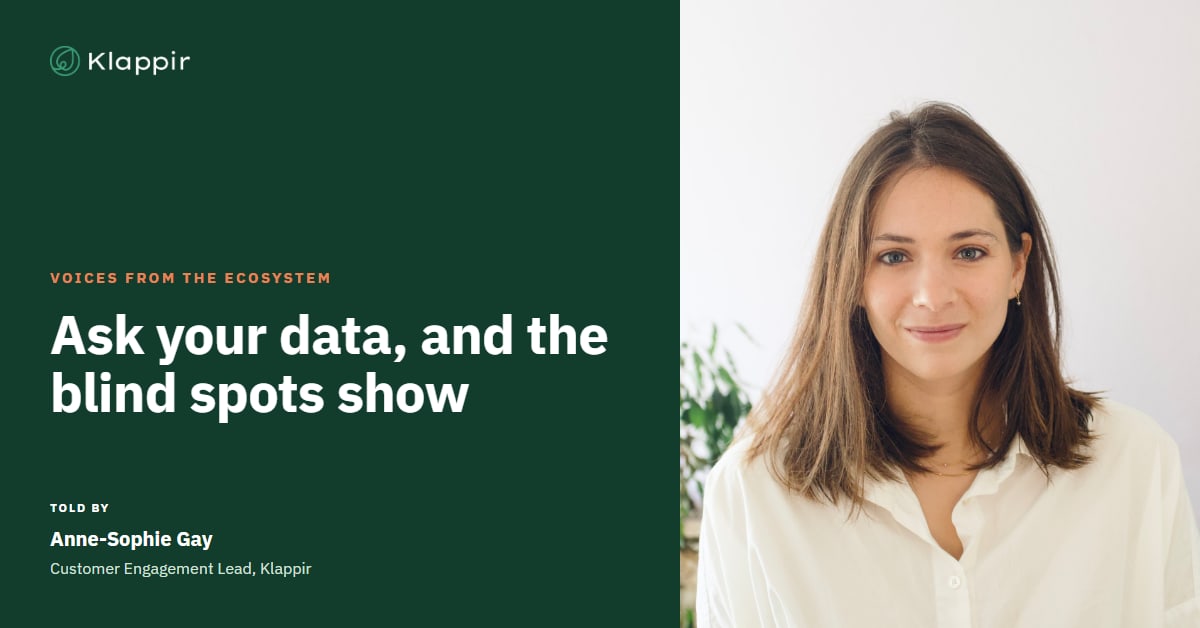
Anne-Sophie Gay, Customer Engagement Lead at Klappir, on one of the biggest barriers in resource management work: the gap between knowing about a risk or an opportunity and acting on it.
“When you can ask your data questions directly, you start to notice your blind spots.”
In the first article in our Voices from the Ecosystem series, Klappir co-founder Dr. Jón Ágúst Thorsteinsson looked back on forty years of resource efficiency. This time we hear from someone who sees the same work from a different angle. Anne-Sophie leads Klappir’s engagement strategy, along with the knowledge base and on-demand guidance and support for users. Because her work reaches many users at once, she gets a clear view of the patterns: what helps people move forward, and where they tend to get stuck.
Her background is in human geography and the environment, with a master’s in Environmental Communication and Management. She is also lead author of a peer-reviewed study, Climate labels and the restaurant industry, which looked at how resource use and emissions data from food, and the way it’s communicated, can help close the gap between knowing about a problem and acting on it.
From gut feeling to data-driven action
We asked Anne-Sophie what still holds companies back when it comes to acting on their resource data.
“In many companies, decisions about energy, waste and materials still run on habit. ‘We’ve always done it like that,’” says Anne-Sophie. “Others go on gut feeling: a sense of which site uses the most, or where costs are creeping up. That instinct can be right, but it’s hardly enough to base business decisions on. And without resource data, there’s no way to know what you’re missing.”
“Sustainability can feel big, intimidating and hard to grasp,” she says.
But at its core, sustainability is simple. It’s about being able to keep doing what you do over the long term, without running out of the resources you depend on or damaging the environment along the way. That makes it a question of resources, and resource use is something you can measure.
Ask your data
We asked her where AI is genuinely helping resource management work today.
She sees AI making a real difference, not as a replacement for good data or good judgement, but as a way to make the data easier to work with. “When you can ask your data questions directly, test scenarios and see what happens when you make decisions on a partial picture, you start to notice the silent inefficiencies, missed opportunities and blind spots. That’s when you actually want to do something about them.”
“When something abstract becomes concrete, almost tactile, people relate to it differently,” she says. “You can see the impact of inefficient resource management, what you’ve been missing out on, and what to do about it to reach your goals.”
Waste is a good example. “Many companies know roughly how much waste they produce, but not what’s in it,” she says. “When you break the data down by waste type, you often find that a lot of what ends up in mixed waste could have been sorted. That’s a cost you don’t need to pay, and emissions you could have avoided.” She has seen what happens when that becomes visible. One construction company in Iceland raised its share of sorted waste from 50% to 80% in three years, more than doubled its recycling rate, and cut its cost per kilogram of waste by 35% within a single year.
In practice, it can be as simple as asking. “Instead of digging through reports, you can just ask,” she says. “Which of our sites has the highest share of mixed waste? How has our sorting rate changed since last year? What would we save if we sorted half of our mixed waste properly? Which waste types cost us the most per kilo? The answers show you where to act.”
Track AI like any other activity
We asked her where AI is overhyped.
Her answer starts with AI’s own footprint, from the land, electricity and water data centres use to growing electronic waste. “It can’t be overlooked, and it has to shape how, where and whether AI is used at all,” she says. “Companies should know how much AI they use, for what, and with what impact. You can’t set goals or guardrails for something you aren’t measuring.”
And AI is only as good as the data behind it. “Poor or incomplete data leads to unreliable, and sometimes simply wrong, findings. We still need our own critical thinking.”
More data isn’t always better
We asked her about the most common wrong assumption companies make when they start on Scope 3.
“We tend to think the more we know, the better. But trying to build a one-to-one copy of your entire operation often creates more noise and maintenance work than useful insight.” The companies that do well start with the activities that matter most to them, often using a materiality assessment and the frameworks they report against to decide where to begin.
What makes a good first year
We asked what separates companies that do well in their first year from those that struggle.
“It all starts with knowing why you’re doing this,” she says. That might be compliance, a certification such as Green Key or SBTi, or simply using resources more efficiently. The goal decides what comes first. “And you’ll know you’re off to a good start when every data type has a source, a named owner and a backup contact.”
Put your data to work
“Reporting is one use of the data, but it’s not where the value stops,” she says. “Once you know what’s in your data, you can see what’s possible. AI helps you connect the dots, and it takes some of the fear out of acting, because the risks and consequences that felt unknown become visible. Then action is just the natural next step. AI can suggest, so you can decide, and act.”
Voices from the Ecosystem brings together experiences like these from the people around Klappir, because no single view covers it all.
Want to see what your own data can show you?