
Get the data right, and the reporting follows
After forty years working on resource efficiency, Klappir co-founder Dr. Jon Agust Thorsteinsson says companies are asking a different question now. They used to ask whether they had the data at all. Now they ask whether they can trust it and run their organisation on it.
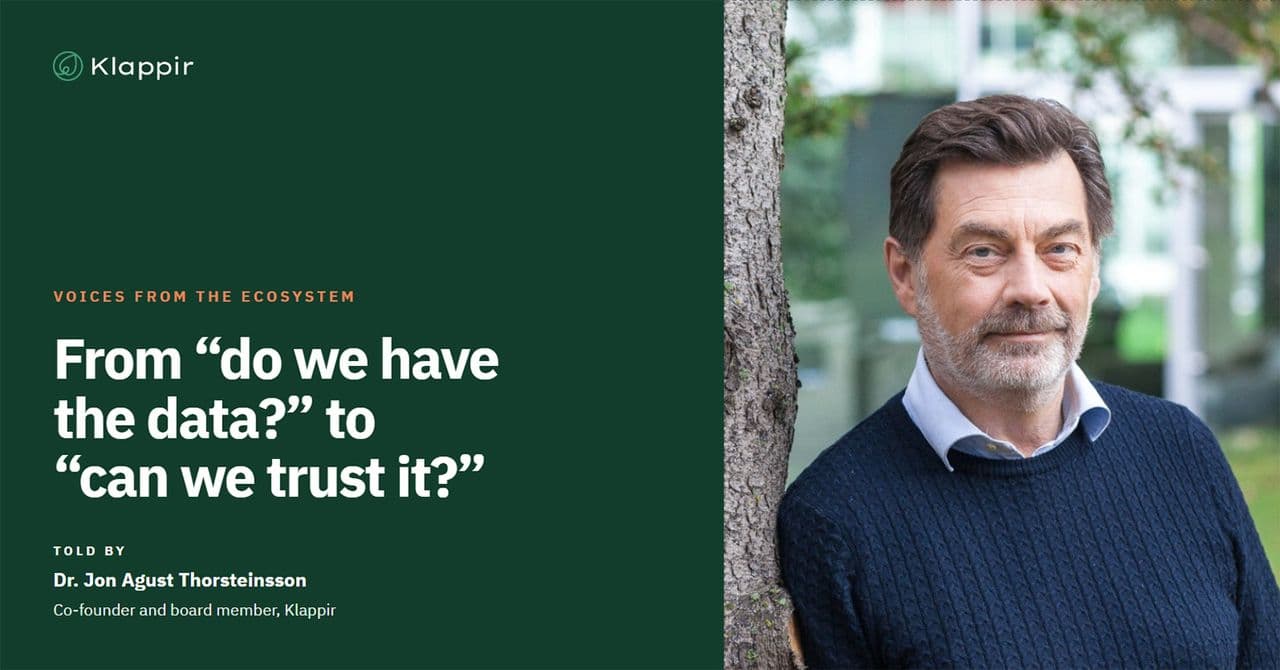
For more than forty years, Dr. Jon Agust Thorsteinsson has worked on one question: how do we get more out of the resources we use?
He began his career in 1985 at Johnson Controls in Denmark. He later co-founded Frost Refrigeration and then founded Marorka (now Ascenz Marorka), which focused on energy-efficient shipping solutions. In 2014, he co-founded Klappir, where he is now a board member, on a simple conviction: you cannot manage what you cannot measure, and you cannot measure what you have not structured.
From having data to trusting it
We asked Dr. Thorsteinsson what has changed since 2014.
"When we started, companies were asking: do we have the data at all?" he says. "Today the question is: can we trust our data, and can we use it to run our organisation more efficiently? That is a completely different conversation. Reporting matters, but it was never the end goal. Get the data right, and the reporting follows."
Why activity data is hard to get right
We asked Dr. Thorsteinsson why activity data is so difficult to get right.
In his view, the hardest part is understanding where each unit of energy actually comes from. Electricity can be generated from hydropower, geothermal, wind, solar, nuclear, natural gas, coal, or oil, and the mix changes by country, season, and even hour. Renewables differ too: a hydropower reservoir, a run-of-river plant and a geothermal plant each have their own production profile.
"Heating and cooling are just as complex," he says. "District heating can come from geothermal water, waste incineration, biomass, combined heat and power from gas or coal, or oil boilers. Cooling can come from electric chillers, seawater or waste heat from industrial processes. Fuels add another layer. Diesel, petrol, natural gas, biofuels and timber all behave differently, and biomass has its own accounting rules. Two buildings with the same consumption can have very different environmental footprints. That is why every unit of energy data needs to carry its source and production method with it."
How AI changed Klappir
For Dr. Thorsteinsson, AI is not a new arrival. "When I was doing my PhD, I worked with optimisation, simulation, non-linear models and machine learning to model energy systems on ships," he says. "The tools have become far more powerful since then, but the principle is the same: the models are only as good as the data you give them."
That is why Klappir has been deliberately careful in how it uses AI. In his view, that caution is a strength, not a limitation. "Trust is the foundation of working with resource data. AI can create enormous value from well-structured data, but only if that trust is protected every step of the way."
Structure before AI
He also warns against a common misunderstanding. "Many companies believe they can point AI at a general dataset, for example an export from their ERP system, and get meaningful answers without building the necessary structure around it first," he says. "But an ERP system is built for finance. It records amounts, accounts and cost centres. The same supplier can appear under three different names, one invoice line can mix energy with service fees, and units are often missing altogether.
"AI will still give you an answer, and it will sound very convincing. But without structure, the answer is built on guesswork. AI does not fix bad data. It scales it. The real work is to structure the data first, with the right units, sources and coding, and then let AI do what it is good at: finding patterns, flagging anomalies and pointing to where resources are being wasted."
Savings drive change
In Dr. Thorsteinsson's experience, savings, not the report, drive change. "When companies and municipalities see that their data can show them where to save costs, the conversation changes," he says.
The difficulty is that the information needed to find those savings rarely sits in one place. Take waste. The volumes are in the hauler's reports, the prices are in the contracts, and the costs are spread across invoices, often coded differently by each supplier. "Each document looks complete on its own," he says. "The picture only appears when they are put together on the same structure, with the same units and the same definitions. That is when patterns start to show, often in places nobody thought to look. So the data was always worth collecting. Not only for the report, but for running the organisation better."
Efficiency and footprint
Looking ahead, Dr. Thorsteinsson sees resource data moving out of the annual report and onto the agenda of top management, as part of the day-to-day running of the business.
"Every environmental footprint comes from using resources," he says. "If you use less energy and fewer materials to produce the same thing, you lower both your costs and your footprint. Efficiency on its own does not guarantee a lower footprint, but it is the most dependable place to start, because it is where cost and impact point in the same direction."
Data that holds its meaning between organisations
The last point is the one he returns to most often. Resource data does not stay inside one organisation. It moves between suppliers, customers, utilities, municipalities and investors, and every time it moves, meaning can be lost. "Granular and canonical data is the foundation for all of it," he says. "Detailed enough to show where resources are used, and structured the same way everywhere so it can be compared and shared between companies and countries. When data is defined the same way on both sides of an exchange, both sides can trust it. That is the groundwork. What AI can do with it comes next."
Interested in learning more
Where are your resources being used, and where is the saving hiding? Klappir helps organisations structure their energy, waste, and resource data so they can analyse, compare, and act on it. Book a conversation with our team to see what your own data can show you.
Contact us
Klappir
Klappir Green Solutions
Klappir is a sustainability data platform that helps organizations measure, manage, and report their environmental impact.