Your fuel suppliers record every litre you buy, by card, vehicle and station. Freight partners know what they moved for you and how far. That data reaches you as statements and exports, so underused vehicles and costly routes are hard to see until the annual figures come in.
What you can do
19%lower Scope 1 emissions, 2023 to 2024, M. Goldschmidt Ejendomme
Find the vehicles that cost the most
See fuel use and cost per vehicle, driver group and site. M. Goldschmidt Ejendomme found underused vehicles and moved others to electric.
Every litre and every shipment is classified to international standards and traceable to its source: the fuel card, the statement or the logbook it came from.
Resource dataFuel
Resource dataFreight and transport
Data sourceConnected fuel suppliers
Data sourceFleet and logbook systems
Data sourceStatements and invoices
How it works
01
Data layer
Fuel and transport data is collected once, from your fuel suppliers, fleet systems and freight partners. Every record is tied to a vehicle, vessel, site or route.
02
Ecosystem
When your fuel supplier or freight partner is in the ecosystem, it shares its data with you directly. You share the results with customers who ask about the transport behind their goods, in the format they need.
03
Platform
Where are we losing money? See fuel cost and use per vehicle and route, which vehicles sit idle, and where a change of fuel or vehicle pays off.
How Eimskip traces fuel and emissions from ship to shore
“It identifies non-financial factors that influence the footprint of our value chain. We were able to reduce emissions and waste and improve the sustainability of the entire operation in no small part thanks to the Klappir sustainable platform.”
Eyþór H. ÓlafssonEimskip
Embla
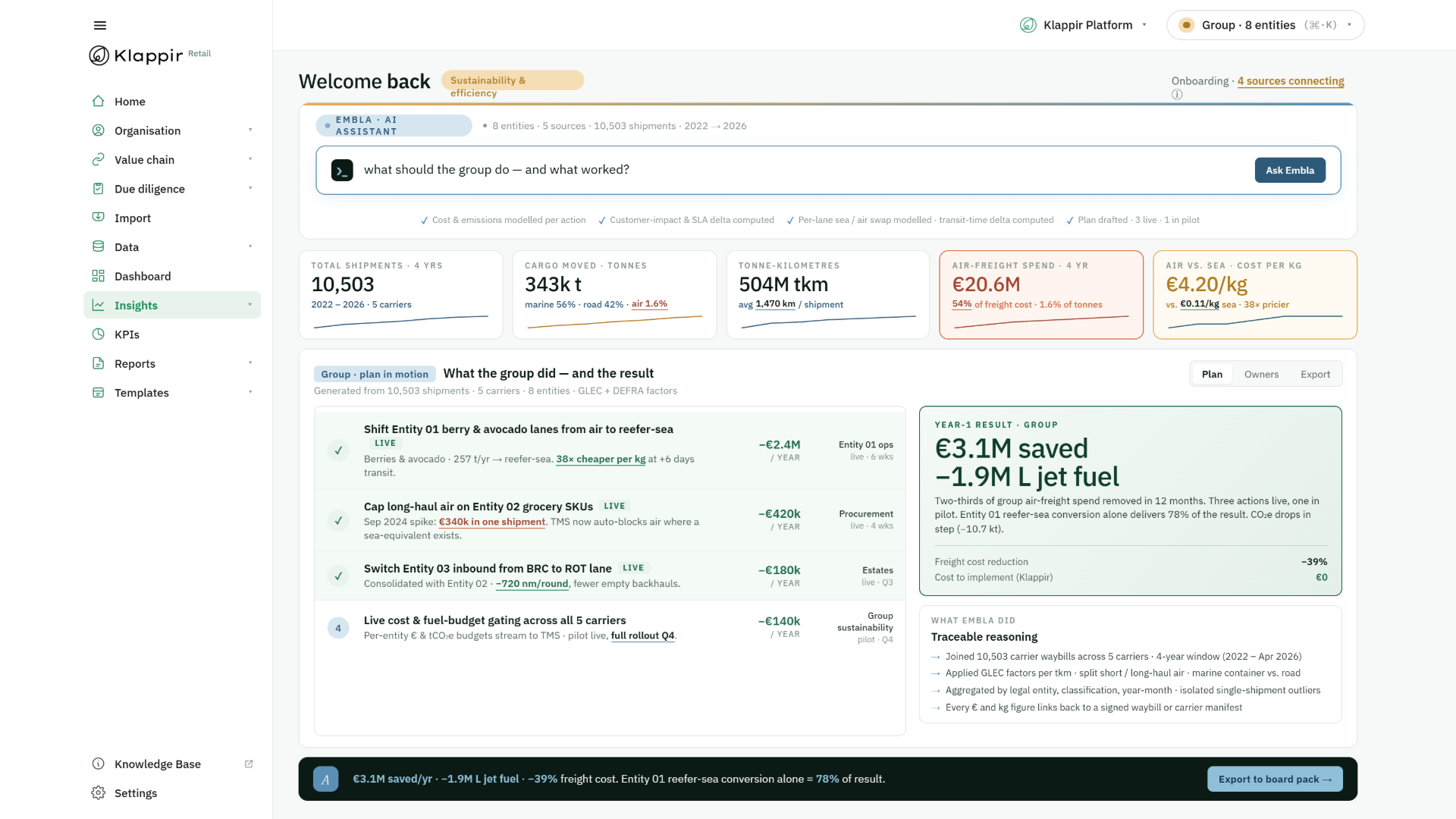
Embla analyses your fuel and transport data and points to measurable cost savings, such as vehicles that are rarely used. Embla suggests. You decide. Klappir Lab is in early access.
From your fuel suppliers, fleet systems, statements and your own files. When a fuel supplier is connected as a data partner, its data arrives by card and vehicle without anyone chasing it. Other data can come in as uploads, scheduled files over SFTP or through the API.
Can we see fuel use per vehicle?
Yes, where the vehicle or card is in the data. Each record is tied to a vehicle, site or legal entity, so you can compare use and cost between vehicles and spot the ones that are rarely used.
Does it cover vessels and freight?
Yes. Vessel data, freight and transport sit next to your road fleet. For shipping, LogCentral digitalises logbooks on board and shares the data between ship and shore.
How does fuel data reach our climate accounts?
Emissions are calculated from the same records, built on the foundations of the GHG Protocol. Your own fleet is Scope 1 and purchased freight is Scope 3. Every result links back to the record and the factor applied.
What does it cost to start?
The Core plan is free, with one free data connection included. Core gives you the platform and lets you share and receive data. Your suppliers and customers join Core for free too.
Your value chain may already be here
More than 4,500 organisations are in the ecosystem, built around 700+ customers in 26 countries. Core is free to join on both sides of the value chain, includes one free data connection, and is what you need to share and receive data.