

Eimskip: Traceable emissions data across a global fleet, from Iceland to 20 countries
How Iceland’s only pan-Arctic ocean carrier uses Klappir to ensure the traceability, transparency, and auditability of sustainability data across one of the most complex operational footprints in the North Atlantic.
110 years of moving the world’s cargo. A growing obligation to account for it.
Eimskip is Iceland’s only merchant shipping company headquartered in the country, and one of the most operationally complex organisations in the North Atlantic. Founded in 1914, the company operates 16 vessels across six sailing routes, runs terminals in 14 locations across five countries, and offers freight forwarding services from 29 offices in 20 countries. In 2024, Eimskip transported 2.6 million tonnes of cargo and generated revenue of EUR 847 million.
The operational footprint is genuinely global: vessels burning marine fuel on the North Atlantic, diesel trucks on Icelandic roads, refrigerated warehouses from Reykjavík to Rotterdam, forwarding offices from Qingdao to São Paulo. Every one of those assets generates resource data. Making that data traceable, consistent, and externally verifiable across 21 subsidiaries is not a reporting task. It is an infrastructure problem.
Emissions data across a global, multi-modal fleet
Shipping is one of the most data-intensive industries for emissions accounting. Marine fuel consumption, fugitive refrigerant emissions, shore power usage, trucking fleets, terminal equipment, and warehouse heating each follow different measurement conventions, regulatory frameworks, and verification requirements.
Meeting multiple regulatory frameworks simultaneously requires emissions data that is not just collected, but structured consistently enough to be recalculated when methodologies change, and auditable at every step.
Eimskip operates across jurisdictions with differing standards. Without a governed data foundation, historical recalculations become guesswork, cross-subsidiary comparisons break, and external verification has nothing to stand on.
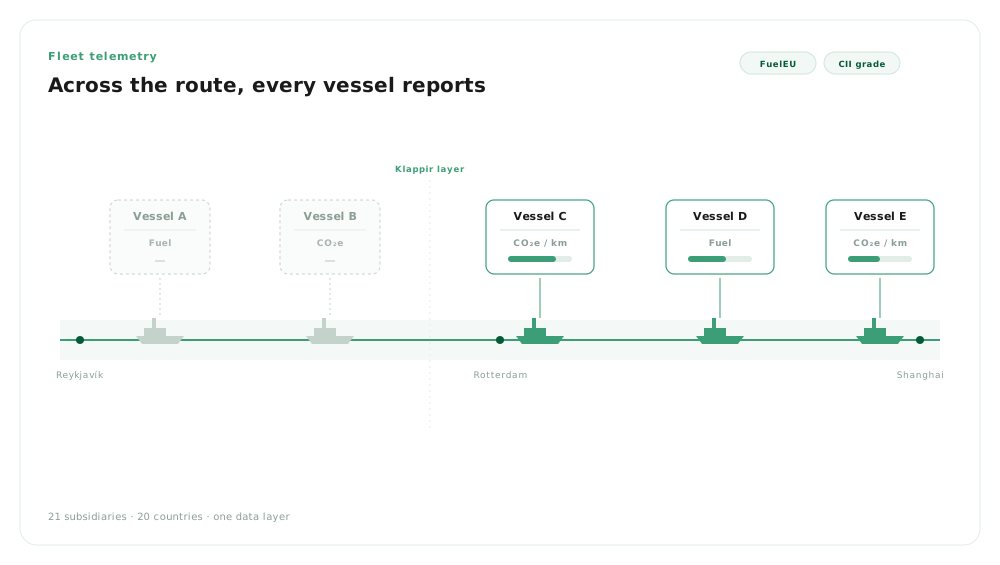
Klappir as the data foundation for the ESG statement
Eimskip uses the Klappir Sustainability Platform to ensure the traceability, transparency, and efficiency in data collection, processing, and dissemination of environmental information across the group. Klappir’s sustainability specialists review and assess the data underlying Eimskip’s annual ESG statement, in accordance with the principles of the Greenhouse Gas Protocol.
The scope covers the full operational boundary: vessel fleet, trucking, terminals, warehouses, and offices across 20 countries, structured in a single governed data foundation.
When Eimskip expanded its GHG accounting in 2024 — moving from CO₂ to CO₂e for marine fuels, adding Scope 3 Category 3 for the first time, and recalculating historical data back to 2015 — that work was possible because the underlying data infrastructure could support it. Methodology improvements don’t require rebuilding the data. They require a foundation built to evolve.
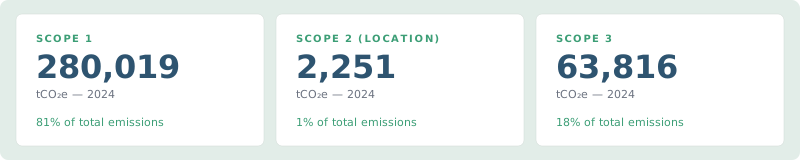
The results
Precision that holds up under scrutiny
Carbon Intensity
Reduction in GHG emissions per transported ton since 2015 baseline
Waste & Resource Recovery
Waste recovery rate in 2024
- 2 methane-powered trucks added to road fleet
- First electric mobile harbour crane in Faroe Islands commissioned
- Shore power installed at Sundhöfn for container vessels
Regulatory Alignment
Methodology Evolution
- Marine fuel emissions recalculated from CO₂ to CO₂e, with historical data back to 2015 restated
- Scope 3 Category 3 (fuel- and energy-related activities) added for the first time in 2024
- Vessel energy independently validated by Verifavia alongside Klappir ESG statement review
“Managing emissions data across a global fleet — vessels, trucks, terminals, and warehouses across 20 countries — requires more than good intentions. It requires a data foundation you can trust. Klappir gives us the traceability and structure that makes our sustainability reporting credible, not just compliant.”

A stable data layer under a changing regulatory environment
Eimskip’s net-zero target covers Scope 1 and 2 by 2040. The path there runs through energy transition — methanol, ammonia, hydrogen, and methane as marine fuels — and depends entirely on the availability of green energy infrastructure and transparent pricing of new fuel sources, both of which remain uncertain.
What is not uncertain is the data foundation required to navigate that transition responsibly. Every investment decision, every fuel switch, every route optimisation depends on emissions data that is accurate, comparable across years, and trusted by regulators, investors, and auditors. As the regulatory landscape continues to evolve — IMO GHG strategy, FuelEU Maritime, EU ETS — the platform provides a stable data layer underneath a changing compliance environment.
That’s what the infrastructure is built to provide.
Common questions
What teams most often ask about this story.
Operational data flows in continuously from each vessel, terminal, and subsidiary, classified against a shared group-wide standard. Every record is attributed to the right entity, route, and period, so group-level figures are built from the same structured foundation as local ones.
Yes. Each record carries its full lineage through the data infrastructure — from source system to vessel or site, to voyage or period, to the emission factor applied. Audit trails are built continuously, not assembled retroactively.
Structured activity data — fuel, distance, cargo, voyage metadata — is the foundation both CII and EU ETS reporting depend on. With the data governed once, the same records feed both regulatory outputs and internal performance tracking.
Have a different question?
Talk to our team about your organisation’s data infrastructure.
Ready to see what your resource data can do?
See how resource data infrastructure fits your organisation in a 30-minute walkthrough. We’ll look at your current data landscape and show you how a continuous foundation replaces the annual rebuild.
No commitment. No sales deck. Just a conversation about your data.