
Carbon accounting is only as good as the number you can defend
Calculating emissions is straightforward. Producing a number you can trace, explain, and stand behind when the methodology changes — that's the harder problem. It starts with the data, not the tool.
The challenge
The calculation is the easy part. The data underneath it isn't.
The inputs don't agree
One system records fuel in litres, another in m³. Inconsistency at the input level compounds silently until someone asks a question you can't answer.
The number has no history
An auditor asks where a specific Scope 2 figure came from. The answer involves a spreadsheet, a conversion factor someone looked up last March, and a number that can't be independently verified.
Methodology changes reset everything
Emission factors update. Regulations require a switch in the calculation method. Each change forces manual rework of historical data — breaking year-over-year comparability.
A number you can defend starts with data that was built to be defended.
Most carbon accounting tools do the multiplication correctly. The real issue is whether the inputs are consistent, traceable, and properly governed enough to produce a defensible number.
Organisations struggling with carbon accounting aren't picking the wrong tool. They're working with data that was never structured to withstand scrutiny. Collected haphazardly, stored inconsistently, assembled only at reporting time — it generates a number, but one without real substance behind it.
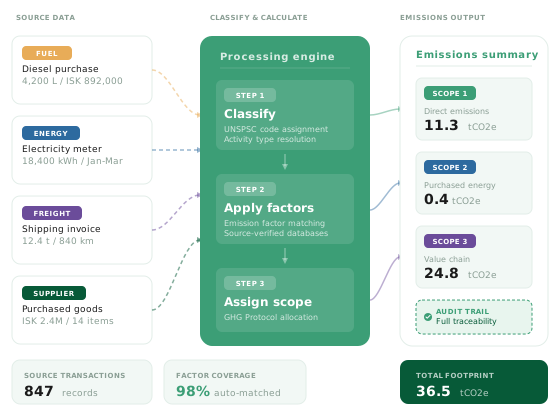
Klappir captures operational data continuously, classifies every record against a shared canonical standard, and preserves an immutable audit trail from source to calculation. When methodology changes, source data stays intact and the calculation logic updates. When an auditor asks where a figure came from, the answer is already there.
In practice
The system is a godsend not only for us who do the environmental reporting but also for our machinists and engineers, who now have a comprehensive overview of the energy intensity of every single machine.
Ölgerðin — Beverage manufacturing
How it works
What changes when the number is built on infrastructure
Typical tool: Upload spreadsheets or enter data manually at reporting time. With Klappir: Operational data flows continuously from systems, suppliers, and files.
Typical tool: Depends on whoever prepared the spreadsheet. With Klappir: Every record classified to a shared standard (UNSPSC) automatically.
Typical tool: Manual lookup and application. With Klappir: Automatic based on classification, supplier, location, and validity period.
Typical tool: Assembled after the fact for assurance. With Klappir: Built continuously — every source, change, and calculation recorded.
Typical tool: Reprocess manually or start fresh. With Klappir: Source data preserved; calculation logic updates; history recalculated.
Typical tool: Comparability depends on whether the same person used the same method. With Klappir: Consistent structure across all years, entities, and reporting periods.
Typical tool: Separate data collection from each supplier. With Klappir: Supplier data contributed once through the ecosystem, reused across customers.
Common questions about carbon accounting
Answers to the questions we hear from organisations evaluating their carbon accounting approach.
Scope 1, 2, and 3. The platform captures direct emissions from owned operations, indirect emissions from purchased energy, and value chain emissions including purchased goods, transportation, and business travel.
Emission factors are applied automatically based on each record's classification, supplier, location, and time period. When factors update, historical calculations can be recalculated without re-entering source data.
Source data is preserved with an immutable audit trail. When calculation methodology changes, the platform updates the logic and recalculates historical periods automatically, maintaining year-over-year comparability.
Yes. Every emissions figure traces from the reported total through entity, site, transaction, classification, and emission factor. The full chain is maintained automatically for audit and assurance.
Supplier data is contributed once through the Klappir ecosystem and reused across all customer relationships. This replaces questionnaire-based collection with structured, comparable data.
Yes. The continuous audit trail, consistent classification, and traceable calculation chain are designed to meet the requirements of limited and reasonable assurance engagements.
Ready for a carbon accounting number you can actually stand behind?
See how structured data infrastructure changes the way your organisation calculates and defends its emissions figures. Trusted by 700+ organisations across 50+ countries.
No commitment. No sales deck. Just a conversation about your data.