
CSRD readiness isn't a reporting problem. It's an organisational one.
Most organisations approaching CSRD are building for this year's disclosure. The ones that won't struggle in year three built something that works across entities, across years, and across a regulation that isn't finished moving.
The challenge
CSRD exposes organisational data problems that reporting tools can't fix
ESRS requires data at the entity level, by site, by subsidiary, by country of operation. Most organisations can produce a consolidated figure. Far fewer can produce the underlying breakdown in a form that an auditor can verify. The report gets filed. The gaps stay hidden until the assurance scope widens.
CSRD requires comparability across reporting periods. That means the 2025 and 2027 figures need to mean the same thing, use the same methodology, have the same boundary, and follow the same classification logic. Organisations that built their first disclosure manually have no guarantee of that consistency.
ESRS sector-specific standards are being phased in through 2026 and beyond. The EU Omnibus revision adjusted scope thresholds in 2026. What CSRD requires next year will not be identical to what it required this year. Organisations built around disclosure templates are constantly rebuilding. Organisations built around a stable data foundation are not.
Compliance that holds across years starts with a system built to last.
CSRD readiness isn't a reporting project — it's a data infrastructure problem. Organisations that treat it as the former rebuild every year. Those that treat it as the latter build once and adapt.
Most CSRD preparation starts with the disclosure template and works backwards. That approach generates numbers for this year — but when scope thresholds shift, when ESRS sector standards apply, when your auditor asks for source-level evidence, the template breaks and the work starts again.
Klappir structures data at the entity level continuously — not at reporting time. Every record is classified to a shared standard, linked to its source, and preserved with an immutable audit trail. When the regulation changes, source data stays intact. The calculation logic updates. Historical comparability holds.
The result is a disclosure that can be traced back through every number, every period, every entity — without rebuilding anything from scratch when requirements move.
In practice
Using Klappir together with one of their certified partners helped us bridge the gap between strategy and reporting. The platform provided a strong foundation for collecting data and documentation, which allowed us to focus consultancy hours where they mattered most — on CSRD preparation and strategic development. With a partner who knew both our needs and the platform, the entire process became more efficient and delivered better results.
How it works
What changes when CSRD is built on infrastructure
Typical approach: Manual reconciliation across spreadsheets per entity. With Klappir: Structured entity hierarchy with data collected and consolidated automatically across the group.
Typical approach: Audit trail assembled before each external review. With Klappir: Built continuously — every source, classification, and calculation recorded and traceable from day one.
Typical approach: Comparability depends on whether the same person used the same method each year. With Klappir: Consistent classification and methodology across all reporting periods.
Typical approach: Manual mapping to ESRS data points at disclosure time. With Klappir: Data structured against ESRS requirements throughout the year, not assembled at the end.
Typical approach: Disclosure templates require manual rework as ESRS sector standards and thresholds update. With Klappir: Source data preserved; calculation logic updates; history recalculated.
Typical approach: Separate data requests sent to each supplier per reporting cycle. With Klappir: Supplier data contributed once through the ecosystem, reused across customers and years.
Common questions about CSRD compliance
Answers to the questions we hear from organisations preparing for CSRD and ESRS requirements.
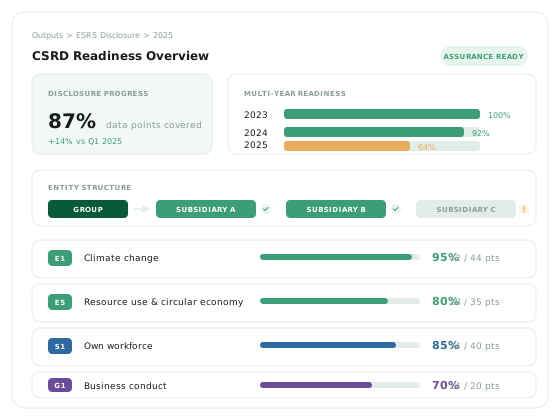
The platform supports data collection and disclosure across all ESRS topical standards, including E1 Climate Change, E5 Resource Use, S1 Own Workforce, and G1 Business Conduct. Coverage extends as sector-specific standards are phased in.
Double materiality assessments are documented and maintained as living records within the platform, connected to targets and actions. When business context changes, the assessment can be reviewed and updated without losing historical context.
The platform is built on a stable data infrastructure, not disclosure templates. When scope thresholds or reporting requirements change, source data stays intact and reporting logic adapts. This is the difference between rebuilding a report and updating a calculation.
Yes. The entity hierarchy ensures every subsidiary operates on the same data infrastructure with consistent classifications and emission factors. Group consolidation is arithmetic, not reconciliation.
Every record is classified against a shared standard from day one. Consistent structure across all reporting periods means year-over-year comparability holds automatically, not because someone remembered to use the same spreadsheet.
Yes. Every figure is traceable from disclosure through entity, site, and source record. The continuous audit trail is designed for both limited and reasonable assurance engagements.
Ready to build CSRD compliance that holds across years?
See how structured data infrastructure changes the way your organisation approaches CSRD — from first data collection to assured disclosure. Trusted by 700+ organisations across 50+ countries.
No commitment. No sales deck. Just a conversation about your data.