
Group sustainability reporting is only as strong as the weakest entity in it
Consolidating sustainability data across subsidiaries, legal entities, and geographies sounds like a reporting problem. It isn't. It's a data architecture problem. When every entity structures data differently, the group total is only as reliable as the least consistent input feeding it.
The challenge
Consolidation built on manual reconciliation breaks at scale
One subsidiary measures energy in kWh while another uses MWh. Waste gets recorded by weight or volume depending on location. Emission factors vary from local to national standards. Inconsistency at the entity level compounds silently until someone asks a question you can't answer.
When a group acquires a new subsidiary, its data practices rarely align with the parent company's standards — forcing a choice between accepting incompatible data or spending months on manual harmonisation before any consolidated reporting is possible.
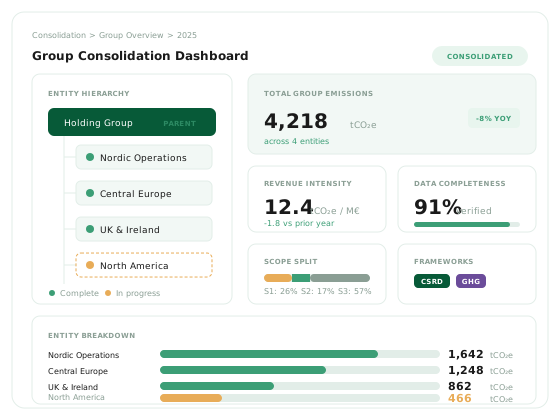
A group-level emissions total masks which entities are underperforming, which ones have data quality issues, or where improvements should focus. Without consistent entity-level structure, tracing from the consolidated number back to its source becomes detective work.
In practice
The platform is the basis for us to set measurable goals when it comes to reducing waste in energy, water, heating and fuel.
Hagar — Retail & distribution group
How it works
What changes when every entity runs on the same infrastructure
Data consistency
Typical approach: Each entity uses its own formats and units; manual normalisation required before consolidation. With Klappir: Every record classified to a shared standard automatically — consistent across every entity in the group.
Entity onboarding
Typical approach: New subsidiaries require months of data harmonisation before they can contribute to consolidated reporting. With Klappir: New entities inherit the shared structure immediately — contributing from day one.
Traceability
Typical approach: Group total cannot be traced back to entity level without manual investigation. With Klappir: Every figure in the group total traceable through entity, site, and source record.
Performance visibility
Typical approach: Aggregated figures mask which entities are underperforming or have data quality issues. With Klappir: Entity-level performance visible alongside group totals — gaps and outliers surface automatically.
Year-over-year comparability
Typical approach: Comparability depends on whether the same person used the same method across all entities each year. With Klappir: Consistent structure across all years, entities, and reporting periods.
Assurance and audit
Typical approach: Group-level audit trail assembled from entity-level files before external review. With Klappir: Audit trail built continuously at entity level — available at group level without additional assembly.
Common questions about group reporting
Answers to the questions we hear from groups managing sustainability data across multiple entities.
New entities inherit the shared data infrastructure immediately. They start contributing structured data from day one using the same classifications, emission factors, and audit trail as every other entity in the group.
Every record across every entity is classified to a shared canonical standard (UNSPSC). Units, emission factors, and calculation methods are applied consistently regardless of geography or local practice.
Yes. Every figure in the group total is traceable through entity, site, and source record. Underperforming entities and data quality issues surface automatically rather than being masked by aggregation.
The acquired entity inherits the group's data structure immediately. There is no months-long harmonisation period. Data begins flowing into consolidated reporting from the point of integration.
The entity hierarchy scales to any number of subsidiaries and sub-groups. Several Klappir customers operate across 50+ entities and multiple geographies on a single platform instance.
Ready to make group reporting a consolidation exercise, not a reconciliation one?
See how structured data infrastructure scales across subsidiaries and geographies without losing traceability or consistency. Trusted by 700+ organisations across 50+ countries.
No commitment. No sales deck. Just a conversation about your data.