
Maritime compliance runs on data. Most of it is still on paper.
Vessel logbooks, waste declarations, MRV reports, port reception records — the maritime industry generates significant compliance data at every point of a voyage. The question isn't whether the data exists. It's whether it's structured, traceable, and available to the people who need it without a physical inspection or a manual data exchange.
The challenge
Maritime compliance is a data problem disguised as a paperwork problem
Manual logbooks create liability
Handwritten logbooks leave vessel operators exposed to transcription errors, missing records, and gaps in traceability that only surface during an inspection — when it's too late to correct them.
Port waste coordination fails
Waste declarations and port reception facility notifications run through disconnected channels — phone, email, paper forms — creating delays, mismatches between what's reported and what's collected, and no shared audit trail.
Fragmented compliance data
MRV data, fuel records, voyage reports, and waste declarations live in separate systems with no common structure. Real-time decisions and cross-voyage analysis require data reconciliation that nobody has time to do between port calls.
Maritime compliance data needs to be digital, connected, and continuous.
Klappir connects vessel operations, port services, and sustainability reporting to a shared data infrastructure — so compliance records exist in one place, in one format, accessible without manual extraction or physical review.
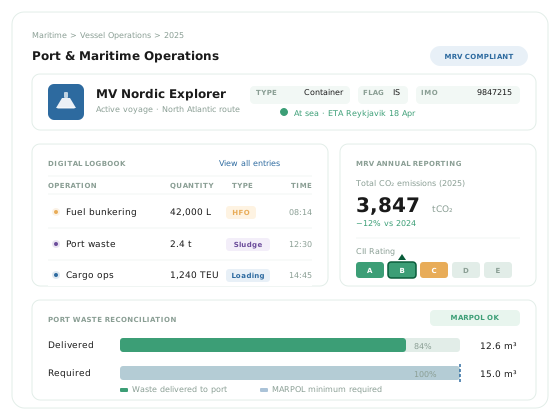
Digital logbooks capture voyage data continuously. Waste declarations are submitted through the platform and linked directly to port reception records, creating an automatic reconciliation between what was notified and what was delivered. MRV data is calculated from the same source records — no re-entry, no separate assembly.
Port authorities, operators, and sustainability teams work from the same data. When an auditor asks for evidence, it's already structured and traceable. When a regulatory requirement changes, the source data stays intact and reporting logic updates — without rebuilding records from scratch.
Eimskip & Faxaflóahafnir — In production
How it works
What changes when maritime compliance runs on structured data
Typical approach: Handwritten or ad hoc digital records with no standard format; errors and gaps surface at inspection. With Klappir: Digital logbook capture with structured fields, automatic validation, and continuous audit trail.
Typical approach: Manually assembled from voyage records and fuel data at reporting time. With Klappir: Calculated automatically from the same source records captured during operations.
Typical approach: Coordinated by phone and email; no shared record between vessel and port reception facility. With Klappir: Pre-notification and confirmation captured in the platform — reconciled automatically on delivery.
Typical approach: Physical inspection or manual data requests each time evidence is needed. With Klappir: Records available on-demand through the platform, traceable from source to disclosure.
Typical approach: Fuel, waste, voyage, and emissions data in separate systems with no common format. With Klappir: Unified in a shared infrastructure — no reconciliation required.
Typical approach: Sustainability reports assembled from operational records at year-end. With Klappir: Emissions, energy, and waste figures available continuously from the same records used for daily operations.
Common questions about maritime compliance
Answers to the questions we hear from port authorities and vessel operators evaluating digital compliance solutions.
EU MRV, IMO DCS, FuelEU Maritime, and MARPOL waste management requirements. The platform captures operational data that serves all these frameworks from a single source.
Vessel crews record operations through structured digital forms instead of handwritten entries. Fields are validated in real time, entries are timestamped, and the audit trail is maintained automatically.
Pre-notification and delivery confirmation are both captured in the platform. When waste is delivered to a port reception facility, the system automatically reconciles what was notified against what was received.
Yes. The platform provides a shared data infrastructure where port authorities, vessel operators, and sustainability teams work from the same records. No manual data requests or physical inspections required.
MRV data is calculated automatically from the same voyage and fuel records captured during operations. No separate data assembly or re-entry required at reporting time.
Ready to bring your maritime compliance data together?
See how Klappir connects vessel operations, port services, and sustainability reporting on a shared infrastructure. Trusted by 700+ organisations across 50+ countries.
No commitment. No sales deck. Just a conversation about your data.