
Supply chain due diligence that doesn't depend on suppliers doing you a favour
Most supply chain sustainability programmes run on questionnaires, follow-up emails, and goodwill. When the data comes back inconsistent and incomplete, the problem isn't supplier engagement. It's the process.
The challenge
Due diligence built on questionnaires fails before it starts
Commercial pressure skews responses
Suppliers prioritise responses based on commercial pressure — the biggest customers get complete answers while others receive partial data or nothing. You're really measuring your leverage, not actual performance.
Inconsistent formats, manual reconciliation
Every customer uses different questionnaires and suppliers answer inconsistently, with metrics reported in different units and terminology. Manual reconciliation reintroduces the subjectivity due diligence should eliminate.
Effort doesn't compound
Each assessment cycle doesn't build on the last — the effort required to gather and standardise data remains constant rather than improving over time.
Eimskip — International shipping
Common questions about supply chain due diligence
Answers to the questions we hear from organisations evaluating supply chain sustainability data.
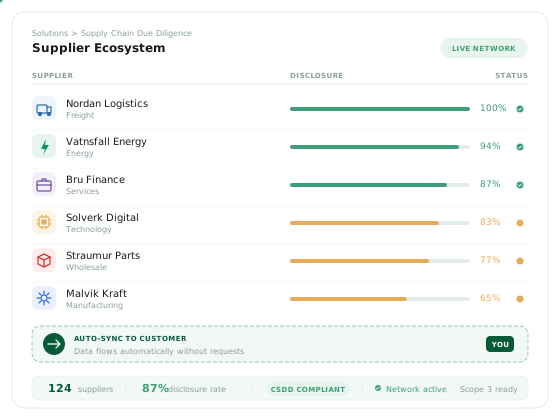
Suppliers join the Klappir ecosystem and contribute their operational and sustainability data once, classified against a shared standard. This data is then available to every customer who works with that supplier.
Coverage grows as more organisations and suppliers join the ecosystem. For suppliers not yet on the platform, spend-based estimates can be used as a starting point, with the path to actual data clearly defined.
Supplier data in the ecosystem feeds directly into Scope 3 Category 1 calculations. Every figure is traceable from the supplier's source record through to your emissions disclosure.
All supplier data is classified to UNSPSC, providing a shared canonical standard across all suppliers and customers regardless of industry, geography, or local practice.
Yes. Instead of sending questionnaires each cycle and reconciling inconsistent responses, you access structured, comparable data that suppliers maintain once in the ecosystem.
Ready to replace questionnaires with structured supplier data?
See how the Klappir ecosystem changes the economics of supply chain due diligence. Trusted by 700+ organisations across 50+ countries.
No commitment. No sales deck. Just a conversation about your data.