

M. Goldschmidt Ejendomme: 49% lower Scope 1, by choice, not mandate
How a family-owned Danish property group cut Scope 1 emissions 49% against its 2023 baseline, hit its renewable electricity goal early, and chose to keep reporting after falling out of CSRD scope.
A family-owned property group since 1979.
M. Goldschmidt Ejendomme is a family-owned Danish property group founded in 1979 by Mikael Goldschmidt, which develops and invests in residential and commercial property with a concentration on long-term value. Managing more than 1,200 leases across over 163,000 m², the group oversees a portfolio valued at around DKK 7.1 billion. A team of 78 people manages letting, operations, service, and administration in-house, creating strong links between day-to-day activities and wider sustainability goals.
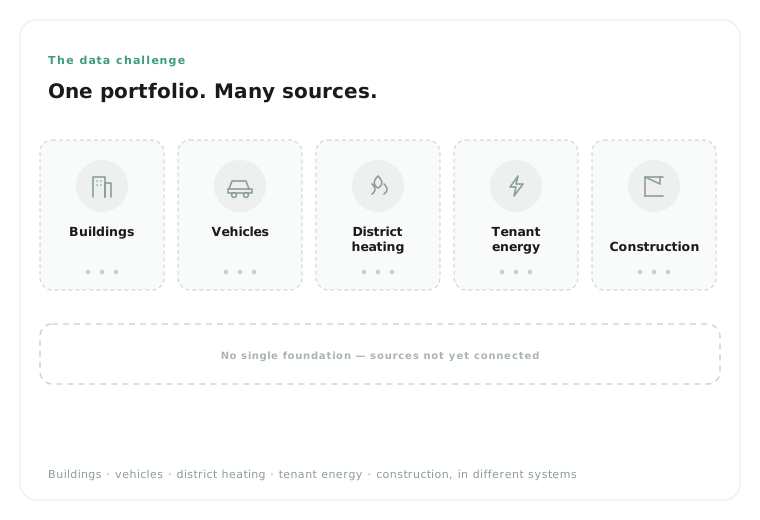
At this scale, sustainability begins as a data challenge before it becomes a reporting one. Emissions come from a diverse mix of buildings, vehicles, district heating, tenant energy use, and ongoing construction, each with its own systems and formats.
One portfolio, many sources, no single foundation.
By 2024, the group set out with ambitious sustainability goals and launched a dedicated ESG strategy. Yet the data needed to support these efforts was scattered across buildings, vehicles, and multiple systems, making it difficult to measure and document progress in a consistent way.
The group’s initial aim was CSRD readiness, leading to the completion of its Double Materiality Assessment in 2024. When the Omnibus changes shifted the requirements, Goldschmidt found itself outside CSRD scope. What happened next speaks to their commitment: rather than pause, the group chose to continue reporting voluntarily under the VSME standard. The data foundation was already creating value beyond compliance, making this the natural next step.
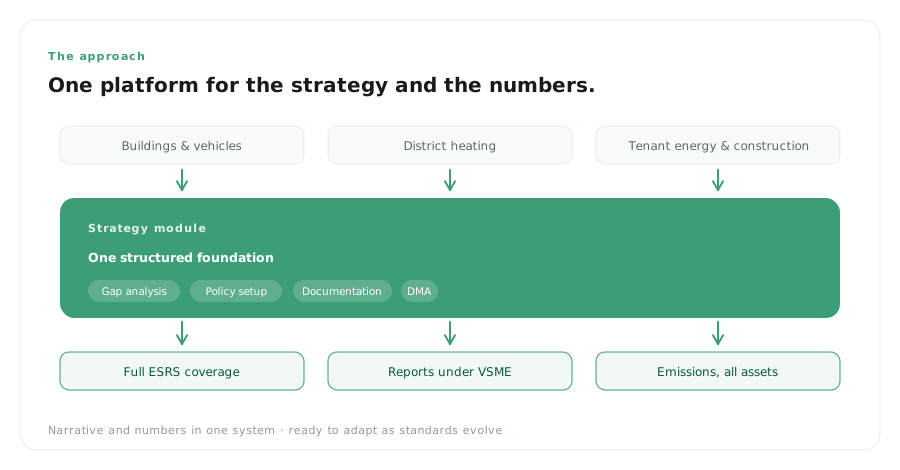
One platform for the strategy and the numbers.
M. Goldschmidt Ejendomme manages its ESG work on Klappir, using the Strategy module as a central hub for all projects. This approach brings everything together: gap analysis, policy setup, documentation, and collaboration, guiding the DMA process step by step and creating a clear, efficient path toward ESG goals.
Alongside strategy, the group uses the Klappir platform to measure emissions across all assets, from buildings to vehicles. This transparency has enabled practical decisions: identifying underused vehicles, switching some to electric, and tracking emissions from rented cars so nothing is overlooked.
By bringing both narrative and numbers into one system, the group achieved full ESRS coverage. When requirements changed, they moved smoothly to VSME, ready to adapt again if needed. Their in-house foundation stays strong, no matter how standards evolve.
The results
Ambitions on paper, turned into measurable results.
Scope 1 down 49%
Direct emissions dropped from 111 tCO₂e in 2023 to 56 in 2025, a 49% reduction that nearly reaches the 50%-by-2028 target ahead of schedule. This progress was driven by electrifying the fleet and phasing out heating oil.
100% renewable electricity
Starting in 2025, all self-controlled electricity is matched with renewable energy from a solar park at Vejle, meeting the 2028 goal ahead of time.
Full Scope 3 baseline
In 2025, the group completed its first full Scope 3 baseline, providing a complete view of indirect emissions and a clear roadmap for future action.
DMA run in-house, 200+ hours and DKK 300,000 saved
The team completed the Double Materiality Assessment and built an ESRS-ready foundation in-house, saving more than 200 hours and over DKK 300,000 in external advisor costs. This work was carried over to VSME when CSRD scope changed.
“Klappir played a foundational role for me in preparing our first DMA. It simplified the process, helped me through each step, and helped me engage management and the board at the right time. It saved us valuable time and eliminated the need for external advisors during preparation, allowing us to focus our input where it truly added value. The dashboards provided visibility, and it was highly satisfying to tick off each step in a clear, well-structured plan.”

A foundation that keeps compounding.
With strategy and platform working together, the group is expanding how it uses data. An IoT district-heating pilot at Store Kongensgade 114 reduced heating use by 24% in its first year, and the approach will be brought to more properties in 2026.
This shift turns sustainability from a deadline-driven reporting task into a structured, in-house discipline, with data always ready to support requests from customers, tenants, lenders, or regulators.
Common questions
What teams most often ask about this story.
Because the data foundation was already delivering value beyond compliance. After the Omnibus changes, the group moved from CSRD to the voluntary VSME standard and kept measuring and reporting. The same platform that supported disclosure also enabled better decisions for vehicles, energy, and buildings.
All data is managed on one platform, with the Strategy module as the central hub. Emissions from buildings, vehicles, district heating, tenant energy, and construction are brought together in a single, structured environment. This gives the group a consistent overview across more than 1,200 leases, without the need to reconcile separate systems.
Direct emissions from the group’s own activities (Scope 1) fell from 111 tCO₂e in 2023, the baseline year, to 56 tCO₂e in 2025, a 49% reduction. The reduction strategy targets 50% by the end of 2028, mainly through electrifying the vehicle fleet and phasing out heating oil.
Have a different question?
Talk to our team about your organisation’s data infrastructure.
See how the platform fits your portfolio
We’ll look at your current data landscape and show you how a single, owned foundation replaces scattered systems and formats.
No commitment. No sales deck. Just a conversation about your data.