

ÞG Verk: Seven measured years of compounding returns on sustainability data
How one of Iceland's leading construction companies turned early investment in data visibility into a programme that gets more rigorous, and more valuable, every year.
Building in Iceland since 1998. Eight entities. One honest problem.
ÞG verk is one of Iceland’s leading construction and contracting companies, with 20 years of experience building power plants, bridges, schools, offices, and industrial facilities. Today, the company operates through eight wholly owned subsidiaries, with 131 employees and net revenue of ISK 9.6 billion in 2024.
In 2018, the company had an honest problem: it wanted to improve its environmental performance, but had no reliable way to measure it. Waste data arrived as line items on invoices, cryptic product codes with no context. Fuel and energy information was scattered across sites and subsidiaries. Progress on sustainability was driven by individual foremen who happened to care, not by company-wide systems.
The waste sorting ratio, the recycling rate, the cost per kilo of waste, none of it was knowable without a system to collect and structure the data.
ÞG verk started using the Klappir Sustainability Platform in late 2018. The company has measured and published its waste performance every year since 2020, and its 2024 Sustainability Statement is the most complete, precise and comparable publication to date.
Making construction data structured and comparable
Construction is one of the hardest industries for sustainability data. Sites open and close. Equipment moves between projects. Fuel is consumed across a dispersed fleet. Heating and electricity are provided to offices, workshops, and temporary facilities across eight entities.
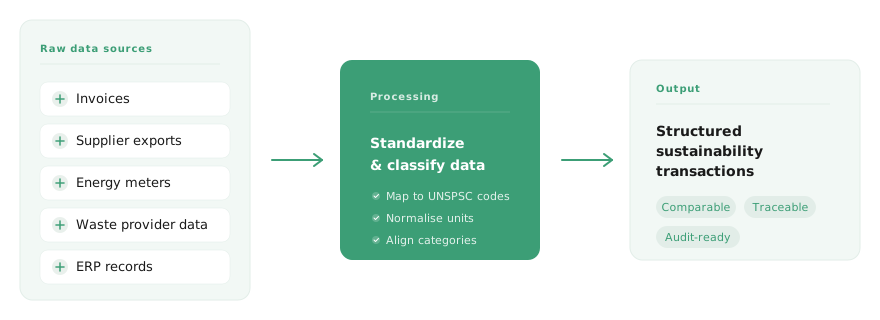
What arrives from service providers is raw invoices, product codes, and meter readings, with no shared structure that makes comparison possible across sites or over time.
Without that structure, a sustainability statement is a snapshot that can’t be benchmarked, verified, or built upon. With it, each year’s data becomes a reliable point in a series, and the series becomes the evidence.
From invisible to visible
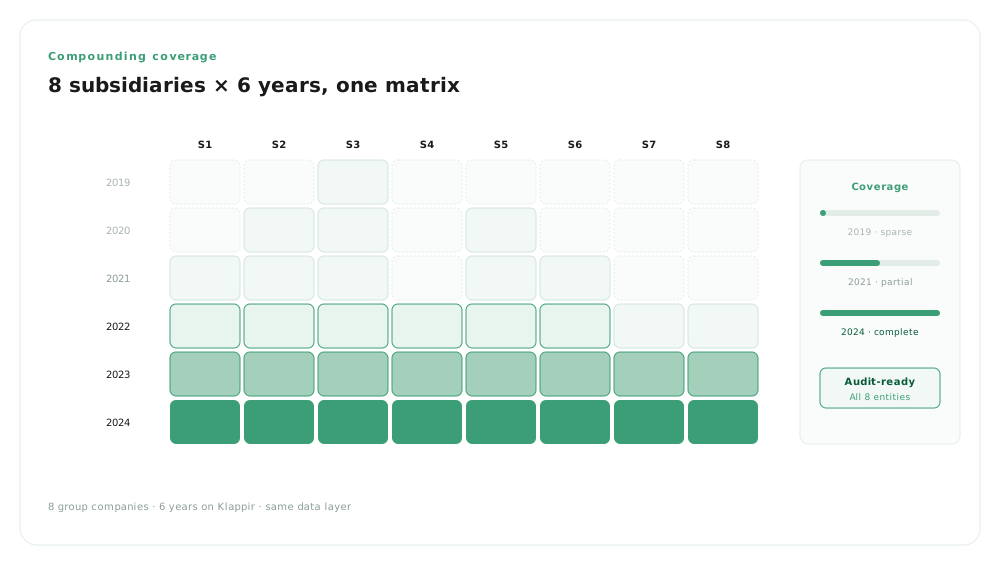
ÞG verk uses the Klappir Sustainability Platform to ensure the traceability, transparency, and efficiency in data collection, processing, and dissemination of environmental information, across all eight entities, assessed in accordance with the Greenhouse Gas Protocol.
Once measurement was in place, the numbers moved fast. By ÞG verk's own published figures, the waste sorting ratio rose from 53% in 2019 to 83% in the first months of 2021, and the recovery rate from 46% to 77% over the same period. The cost side moved with it: in the first half of 2020, the cost per kilogram of waste was 20% lower at fixed prices than the year before, as sorting efficiency improved.
These were not marginal improvements. They were the direct result of making previously invisible data visible, and giving site managers the tools to act on it.
The results: 2021–2024
The verified four-year record
Emissions (tCO₂e)
2024 | 2023 | 2022 | 2021
Operational Metrics
2024 | 2023 | 2022 | 2021
“The problem was that we did not know how much waste we were generating or how much was recycled, the overall information we had was very limited. Implementing the Sustainability Platform was a complete game-changer for us. The waste-sorting ratio has increased from 57% in 2018 to 83% in the first half of 2021, and the recycling rate has increased from 33% to 77% over the same period. We are proud of our results, we publish the waste ratio at the top of our website.”

Year seven: recovery becomes the headline metric
The honest context: site waste volume rose 48% in 2025, from 946 to 1,404 tonnes, as the project mix grew to include the Ölfusá bridge and the new National Hospital. More activity, more waste, and still far better recovery. From July 2025, mixed waste that previously went to landfill is incinerated with energy recovery, and continued sorting on site did the rest.
In its 2025 waste summary, ÞG verk shifted its headline metric from how much waste is sorted to how much is actually recovered. The numbers explain why.
The results
The detail is in the data
Waste recovery rate
Waste recovery rate at work sites in 2025, up from 66% in 2024 and 58% in 2023
That is what seven measured years buy: when the metric that matters changes, the data is already structured to answer it.
Reduction
Reduction in average monthly waste-related carbon emissions: just over 5 tCO2e per month in the first nine months of 2025, against 10.5 per month in 2024
ÞG verk waste summary 2025, published January 2026, work sites scope, not externally assured. Keep these figures out of the 2021-2024 statement tables above.
A data programme that compounds
The annual sustainability statement is now part of how ÞG verk runs the business, not a compliance exercise but a reflection of a data programme that has been compounding since 2018. Each year, the methodology can deepen further: more Scope 3 categories, project-level emissions tracking, supplier data across the value chain.
The value of starting early is not just the results. It’s the baseline, four years of verified, comparable data that makes every future commitment credible.
Common questions
What teams most often ask about this story.
Continuous, structured waste data at the site level gave the team visibility into specific waste streams. Sorting decisions stopped being based on aggregated year-end summaries and became operational, site-by-site practice. The data showed exactly which streams were being mixed and where sorting improvements would have the most impact.
Construction generates data from dispersed, temporary sites where equipment, fuel, and waste move between projects. The platform structures this data at the source so it can be compared across sites and over time, turning raw invoices and meter readings into a governed, auditable record.
Yes. Construction activity is structured at the source: fuel, waste, materials, and energy. This gives CSRD reporting a continuous data foundation rather than an annual rebuild. Six years of historical data means baselines and trends are already established.
Have a different question?
Talk to our team about your organisation’s data infrastructure.
Ready to see what your resource data can do?
See how resource data infrastructure fits your organisation in a 30-minute walkthrough. We’ll look at your current data landscape and show you how a continuous foundation replaces the annual rebuild.
No commitment. No sales deck. Just a conversation about your data.