
Session 1 recap: The data is already there. Can you access it?
In Session 1 of Finance Meets Sustainability, Kirstine Hartung Larsen (K² Nordic) and Höskuldur Arason (DataDrive) walked through a problem most sustainability teams hit early: the data exists, but getting to it is harder than expected. The recording is ready. Fill in your details below, and we'll reveal the link to you.
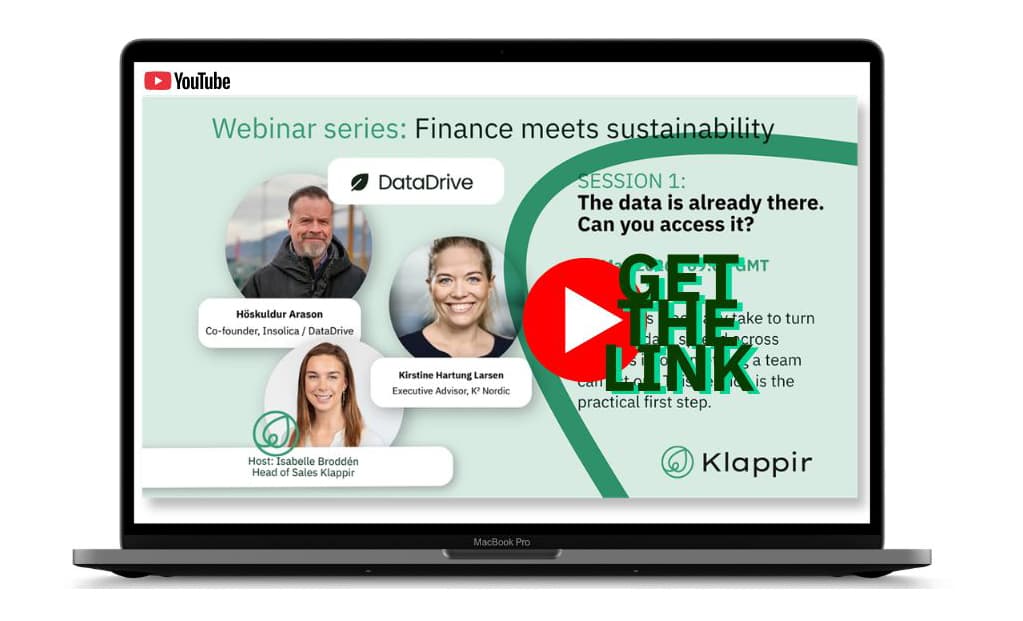
If you missed the session or want to revisit it, you're welcome to the full recording. Fill in the form below, and we'll send it to you directly.
Most sustainability teams are closer to the data they need than they think. That was the opening claim of our first Finance Meets Sustainability session on 21 May, and both speakers spent thirty minutes making it concrete.
Kirstine Hartung Larsen described the starting experience well. As a former Head of Sustainability at a nordic group with more than 11,000 employees and 100 locations, her team began where most do: standing in the dark, able to see a few lights in the distance but with no clear map of the terrain. "We could see a few lights here and there, and we didn't really know where to start. We were kind of making our way through the dark." The issue was not a shortage of data. It was that the data had been built for other purposes, by people optimising for other goals, and finding a route to it took longer than expected.
The ERP system is the obvious starting point. It is rarely enough.
The natural first stop was the ERP system. The logic was sound: audited, documented, embedded in how the organisation already works. If the financial data lives there, surely sustainability data does too. Three to four months later, the team knew that was not quite right. The system could not export data the way they needed. Ownership of different data sets was spread across departments. And what each team described as "good data" turned out to depend entirely on what they were using it for. Good for their purpose, not necessarily good for yours.
The data you need is probably in procurement, not finance
Höskuldur Arason, at DataDrive, who leads ERP and Business Central integrations for Klappir's customers, explains the structural reason. When you open the finance side of a system like Business Central, you find monetary totals grouped by accounting key. You can see that a purchase was made and how much it cost. What you cannot see is what was actually bought, in what quantity, or in what unit. "You don't get the individual lines. You have no idea which products are behind this."
The procurement side is different. It holds individual line items, additional product detail, and in many cases the activity data: kilograms, litres, kilowatt hours. The numbers that sustainability calculations actually need. Höskuldur's recommendation, asked where to start: "I have just one word. Procurement."
Two questions that tell you whether there is something to work with
Before going further, he suggested two quick diagnostic questions for the CFO or finance team.
First: are you actively using the procurement module in your ERP system?
Second: are you sending and receiving electronic invoices?
A yes to both means there is something to work with. A no means the gap between what exists and what is useful will be wider, and the team should know that before investing time in an integration project.
The real obstacle is not the system. It is alignment.
Kirstine's harder-won conclusion took longer to reach, but it may be the more important one. "It's not about the systems. It's more about alignment." Getting sustainability and finance to work from the same definitions (what counts as a spend category, who owns which data set, what level of detail is actually needed for the calculations) is the work that makes everything else possible. Procurement turned out to be the natural starting point for that conversation: "The procurement data was actually our guiding light."
Access and fitness for purpose are two different problems
The session closed with a principle Höskuldur credits to his professor. Getting access to data and having data that is fit for purpose are two different problems. Access is solved by finding the right system and the right contact. Fit for purpose is solved by asking hard questions about what the data was built to do. "Crap in, crap out." It applies at every stage of this work, not just the beginning.
"Successful ESG reporting is not about finding the perfect sustainability data," Kirstine said in her closing remarks. "It is about helping the organisation to better understand the data it already has."
All three recordings in one place, plus the e-book. Fill in the form below to get access. 👇
Klappir
Klappir Green Solutions
Klappir is a sustainability data platform that helps organizations measure, manage, and report their environmental impact.