
Session 3 recap: Stop pitching ESG. Start pitching investments
In the final session of Finance Meets Sustainability, Christian Boserup of ESG Implementation addressed the question that follows every well-researched proposal into the room: why does a good case sometimes still not get funded? The answer, in most cases, is not the data. It is the frame. This session walked through the three frames finance actually responds to, the four layers every fundable business case requires, and the one sentence that determines whether a proposal survives the corridor before it reaches the boardroom.
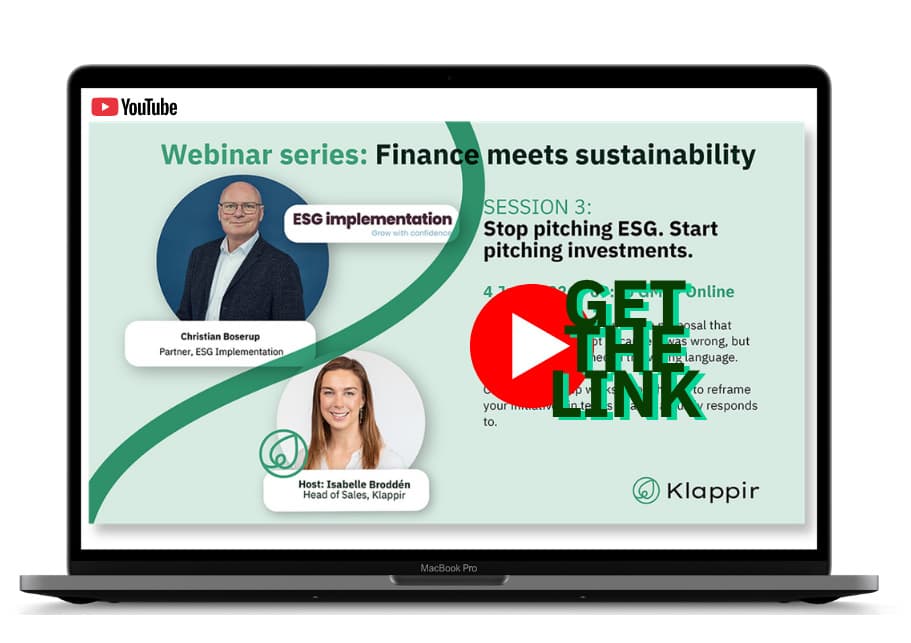
The third session of Finance Meets Sustainability started where many sustainability teams quietly stall. Not at the beginning, when there is still energy in figuring out the data. Not in the middle, when the analysis is taking shape. But at the moment a well-prepared proposal lands on a CFO's desk and does not come back with a yes.
Christian Boserup, ESG Implementation, has spent more than 20 years in management consulting and 15 in financial services. He has sat on both sides of that table, and his opening point was deliberately blunt. "It's not about ideology. It's more about your current competitive position." The companies he works with are not failing to secure funding because their sustainability strategies are unconvincing. They are failing because their proposals are written in a language finance was not trained to read.
ESG is a story about cash flow, not conviction
Christian's first slide made the reframe concrete with three examples. A manufacturing company lost a major customer contract not because of product quality or price, but because it did not meet the customer's ESG supplier scorecard criteria. A mid-sized company went to the bank to refinance and found that ESG data quality was now a condition of favourable lending terms. A development company lost a leadership candidate who turned down the offer because its talent pipeline did not match the ESG profile they were seeking.
None of these is compliance stories. All of them are cash-flow stories: revenue, cost of capital, and talent. The proposal that frames a sustainability initiative as the solution to one of those problems is a different document from the one that frames it as the right thing to do.
The three frames finance responds to
The session introduced three frames for any fundable sustainability case: revenue protection, risk reduction, and operational resilience. Most cases fit more than one. That is an advantage, not a problem. "If your business case fits more than one frame, use the frame that fits your audience best."
A CFO focused on protecting margins will read a revenue-protection case differently from a COO managing operational exposure. A head of sales will respond to customer retention framing in a way that a finance committee reviewing capital allocation may not. The frame does not change what the proposal is asking for. It changes whether the person who controls the budget sees themselves in it.
Two teams that have not been introduced yet
Christian described the gap between the ESG function and the finance and investment committee with a diagram that most sustainability managers will recognise immediately. On one side: material issues, regulatory trajectories, peer benchmarking, strategic risk. On the other side: hurdle rates, budget cycle timing, capital competition, and return on investment. These two teams often work in the same building on problems that affect the same organisation but have not found a shared language.
The practical advice was simple: build the relationship before you need it. Understand when budget cycles open. Learn what a hurdle rate means in your company. Ask someone in finance to explain how capital allocation decisions actually get made. "Become good friends with someone in finance." That is not a soft suggestion. It is the structural condition that makes everything else in this session possible.
Four layers, not one
Most sustainability business cases, when they come before a finance committee, contain one thing: a financial model. A spreadsheet with costs, projected savings, and a payback period. Christian's framework identifies three other layers that are usually missing.
- The first layer is the value logic, which is the sentence that explains what value is at stake and why the decision needs to happen now.
- The second is the financial model, which most proposals over-invest in, chasing precision before the broader case has been made.
- The third layer is feasibility: is this technically possible, is the organisation capable of delivering it, and does it fit the strategic direction the company is already moving in?
- The fourth layer is basic planning: who owns it, what are the milestones, and what is the 90-day proof point that shows this will work?
"All you have is an aspiration with a budget attached" was how Christian described a proposal that addresses only the financial model. The other three layers are what turn an aspiration into a decision.
The sentence that determines whether a proposal survives
The value logic comes down to one sentence. It must contain a number or a range. It must name the mechanism that produces the value. And it must explain why the decision needs to happen now, or be honest that there is no urgency and give a reason to act anyway.
Christian walked through an example from a food company the team had worked with. Their value sentence: "This initiative protects an estimated 45 million in annual revenue from our two largest retail customers by building the Scope 3 supplier data they will require in the 2026 procurement qualification round."
That sentence is specific enough to memorise. It names the value, the mechanism, and the trigger. "The value sentence takes time to build. But you must have it; otherwise, you will not get attention."
The same logic applies when you are adapting the case for different rooms. A CFO, a private equity-backed board, a family-owned business, and a chief revenue officer will each weight risk, return, and resilience differently. One business case, multiple framings. The investment required and the value created do not change. The sentence that opens the conversation does.
All three recordings in one place, plus the e-book. Fill in the form below to get access. 👇
Klappir
Klappir Green Solutions
Klappir is a sustainability data platform that helps organizations measure, manage, and report their environmental impact.