
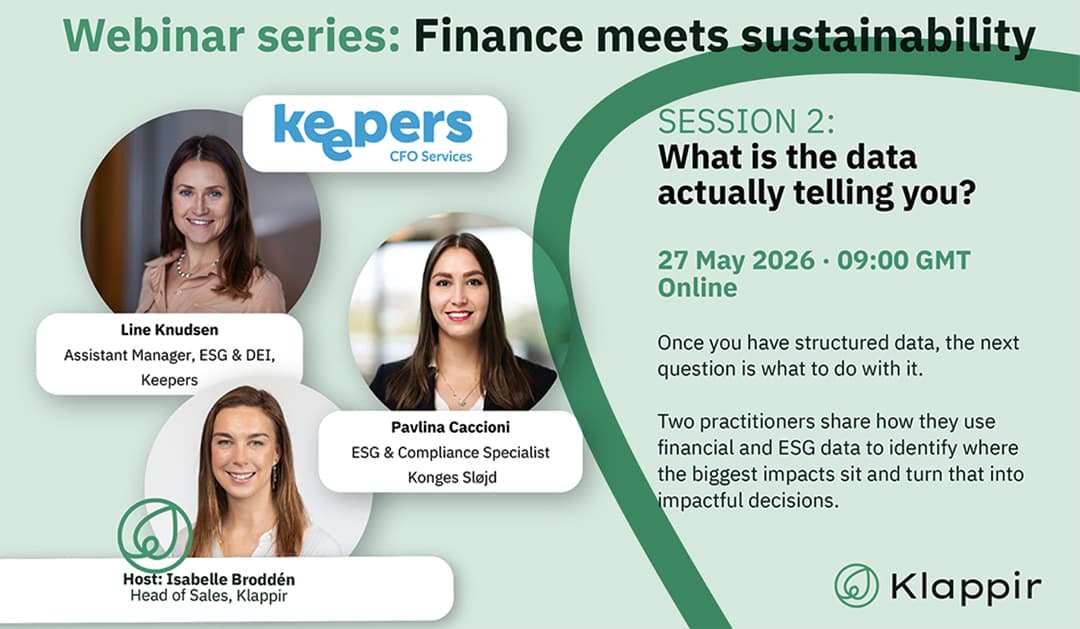
Session 2: What is the data actually telling you?
Most organisations now have more structured data than they know what to do with. The dashboards look good. The numbers agree. And often, nothing changes. In Session 2 of Finance Meets Sustainability, we look at exactly that gap: what happens between the data and the decision, and how to close it.
A few years ago, most operational and sustainability conversations started with the same sentence: "We don't have the data."
That has shifted. Companies that invested in systems, integrations, and data cleanup now have more structured data than they've ever had. The dashboards look good. The numbers agree with each other. Finance, operations, and sustainability can all point at the same chart and say the same word.
And often, nothing changes.
This is the quieter, newer problem. It's not about visibility anymore. It's about what happens between the dashboard and the decision. Most teams stop at the dashboard. They show it in a monthly meeting, someone says "interesting," and everyone goes back to their week.
Visibility is not a decision. A dashboard that isn't tied to an owner, an action, and a deadline is a reporting artifact, not an operational tool. When clean data changes how a business actually runs, three specific moves usually happen first.
Find the hot-spots
Structured data flattens easily into summary totals, but the decisions live in the outliers. Concentration is the signal. One site that uses 40% more energy per square metre than the average. Three supplier categories that make up 80% of waste cost. A shift pattern that quietly moves twice as many kilos of material for the same output. These are the places where small decisions produce disproportionate results. Most teams have this data already. They just haven't asked it the right question.
Prioritise what the data actually shows
Data surfaces more opportunities than any team can act on at once. The instinct is to work on whichever one was mentioned most recently, or the one the CFO walked past this morning. That doesn't produce better decisions. It produces more meetings. Prioritisation based on what the data actually shows, which hot-spot has the biggest effect, the shortest time to act, and the clearest path to a decision, is the move. This is not glamorous and it's where most initiatives quietly fail.
Name an owner
An insight without an owner is a fact with no future. Once a hot-spot is identified and prioritised, it needs a specific person who has the authority to decide something about it, a concrete action, and a deadline that someone will actually track. Without those three, the insight stays in the dashboard and the dashboard stays on the wall.
The quiet mistake is to treat the dashboard as the output. The dashboard is the input. It's the beginning of a cycle that should end with a decision someone made differently because of what they saw. The work of Session 2 is that cycle, walked through with the kind of finance and operations leaders who live inside it every day.
Two voices, one session
Line Knudsen, Assistant Manager, ESG & DEI at Keepers, frames the consulting view: how to surface hotspots, how to prioritise, and how to attach an insight to a named owner with a real deadline. She brings more than seven years of consulting experience helping companies translate financial data into a solid decision-making basis for their sustainability work.
Pavlina Caccioni brings the practitioner view. She led the Klappir implementation as Sustainability Manager at Kurhotel Skodsborg from 2022 to 2024 and now works as ESG & Compliance Specialist at Konges Sløjd. On 27 May she walks through what changed inside the Skodsborg implementation: where the hot-spot was, why that one, who owned it, what they decided, and what the data said six months later.
If you're in a company with cleaner data than last year and a suspicion that not much has changed because of it, Session 2 is built for you. It's 30 minutes, on 27 May at 09:00 GMT. Registration is free and covers all three sessions in the "Finance meets sustainability" series.
The core question of the series is: are you using your data to run the business, or just to report on it? Session 1 showed how to make the data usable in the first place. Session 2 is the first test of whether that work translates into anything different happening.
All three recordings in one place, plus the e-book. Fill in the form below to get access. 👇
Klappir
Klappir Green Solutions
Klappir is a sustainability data platform that helps organizations measure, manage, and report their environmental impact.