
Platform / Data Infrastructure / Data Mapping
Connecting raw data to governed structure
The process that links incoming labels from external systems to the platform's internal suppliers, assets, and classifications.
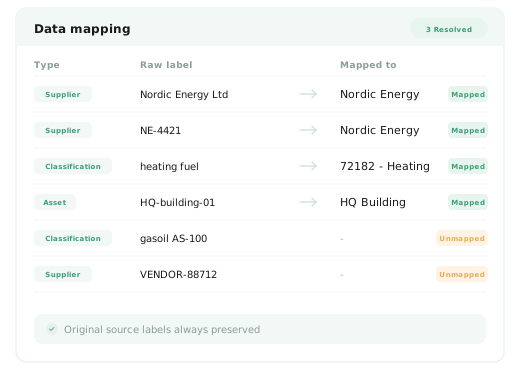
Resolving the gap between external labels and internal structure
When data enters the platform from ERP systems, invoices, supplier files, or any external source, it carries labels that don't automatically match the platform's internal structure. A supplier might appear as "Nordic Energy Ltd" in one system and "NE-4421" in another. A product might be described as "heating fuel" in one file and "gasoil AS-100" in the next.
Data mapping is the process that resolves these differences. It connects raw supplier labels to supplier identities, raw product labels to classifications, and raw asset labels to assets. Once a mapping is established, it applies automatically to future imports. The same label gets linked to the same identity every time.
Mappings can be refined after import. When a mapping changes, historical transactions update structurally and derived outputs recalculate where applicable. The original imported values are never overwritten.
KEY DETAILS
How data mapping works
Data mapping governs how raw labels from external systems connect to the platform's internal identities and classifications.
Three mapping types
Supplier mapping, classification mapping, and asset mapping. Each resolves a different type of external label to a governed identity.
Reusable mappings
Once set, mappings apply automatically to future imports. The same label gets linked to the same identity every time.
Unmapped data flagging
Unmapped data is flagged and visible until resolved. Nothing is lost or hidden during the mapping process.
Emissions recalculation
Classification and supplier mapping changes can trigger recalculation of emissions where applicable.
Asset allocation
Asset mapping changes affect reporting allocation but not emission values. Data moves between assets without changing calculations.
Source preservation
Original source labels are always preserved alongside the mapped identity. The raw import data is never overwritten.
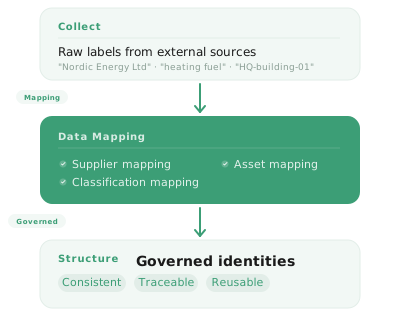
The bridge between Collect and Structure
Data mapping is the bridge between Collect (where data enters) and Structure (where data becomes governed). It's where the platform's consistency is actually created. Messy external labels become clean internal references.
Without mapping, imported data would remain a collection of disconnected labels. With mapping, every transaction links to a supplier identity, a classification, and an asset. That consistency is what makes measurement, reporting, and collaboration possible.
Common questions about data mapping
Answers to questions we hear from teams setting up their data mapping.
It stays visible and flagged until resolved. Unmapped records are not lost. They remain in the platform and can be mapped at any time. Reports and calculations only include data that has been fully mapped.
Supplier mapping links raw supplier labels to supplier identities in the value chain. Classification mapping links product or service labels to UNSPSC codes and emission factor categories. Asset mapping links activity labels to physical or organisational asset records.
When a mapping changes, historical transactions update structurally. Derived outputs like emissions recalculate where applicable. The original imported values are never overwritten, so you can always see what the source data said before mapping.
Each label maps to one identity at a time. If a label needs to point to a different identity, you change the mapping. The previous mapping is preserved in the audit trail, and any affected calculations update accordingly.
Yes. Classification determines which emission factor applies. Changing a classification mapping triggers recalculation of affected emissions. Supplier mapping changes can also trigger recalculation when supplier-specific factors are involved.
Asset mapping affects how transactions are allocated to physical or organisational assets for reporting. Unlike supplier and classification changes, asset mapping changes do not trigger emissions recalculation. They change where data appears in reports, not how it is calculated.
Data Mapping connects Collect to Structure
Once data is imported, mapping resolves raw labels into governed identities. From there, structured transactions flow into measurement, reporting, and collaboration.