
The data you already have is an operational mirror
Your clients are asking. Your auditors are tracing. Your leadership is waiting on a business case. The data they need is almost certainly already within your organisation: your ERP, your procurement records, your invoices. The problem is rarely that it doesn't exist. It's that three specific blockers stand between it and a decision.
Most sustainability teams know what they need to produce; the question is whether the data they already have is in any shape to produce it.
The instinct, when someone asks an operational question the business can't currently answer, is to assume the data doesn't exist yet. That the team needs a new system. A better tool. A dashboard project that will take six months and a consulting budget.
More often, the data is already there. It's sitting in the ERP, the accounting tool, the invoice pile, and the procurement records. What's missing is the path from "we have this" to "we can act on this."
Financial data is an accurate mirror of how a business actually runs. What you spend, who you spend it with, how often, and in what categories all map directly onto your resource flows. Energy, fuel, materials, transport, waste, services. The company's operational shape is already embedded in its financial systems. Most teams just don't have a way to see it with a sustainability lens.
Three blockers between your data and a decision
Between the data and a real decision, three specific blockers tend to show up. Each one can have an adverse effect on the initiative before it starts.
The first is source. Financial data doesn't live in one place. It lives in an ERP, a procurement tool, an invoicing system, an accounting package, a supplier portal, and a set of manually maintained spreadsheets. A very select few in the organisation have a complete map of where every piece is. When someone asks a cross-functional question, half the answer lives in a system they might not have access to.
The second is alignment. Finance sees spend. Operations sees activity. Procurement sees supplier relationships. Sustainability sees emission factors and scope boundaries. These teams are looking at fragments of the same data and calling it different things. Without a shared view of what the data means and who owns it, every cross-team project starts with a vocabulary argument.
The third is structure. Raw financial data is not usable as it stands. A line that reads "Diesel AS-100, invoice 4421, Nordic Energy Ltd" is four different pieces of information: an activity type, a reference, a category, and a supplier. Until that line is categorised, mapped to governed identities, and checked for consistency with the last 400 lines like it, it can't support a calculation or a decision.
The common mistake is to skip these three and jump straight to the dashboard. You can build something that looks good in a demo. It tends to fall apart the moment someone asks a real question, like "can you show me emissions on transport last quarter, broken out by site, compared to the same quarter last year?" If location, alignment, and structure haven't been handled first, the answer is either wrong or weeks away.
What good looks like in practice
What good looks like, in practice, is the hardest question, but luckily it has answers.
Kirstine Hartung Larsen has seen it from the inside. She built and led the sustainability function in a Nordic group with more than 11,000 employees, running dual materiality analysis, ESG data, and ESG systems at scale. Her finding was that it requires strong cross-team collaboration to access the right data, and that it is not always available where you hope to find it.
One of the project examples Höskuldur Arason from DataDrive will walk through on 21 May shows the same pattern: a company whose data sat in the same three systems as everyone else's. Once the team knew where every source sat, agreed on what the categories meant, and mapped them consistently, the dashboards built themselves. And more importantly, the dashboards survived the next hard question.
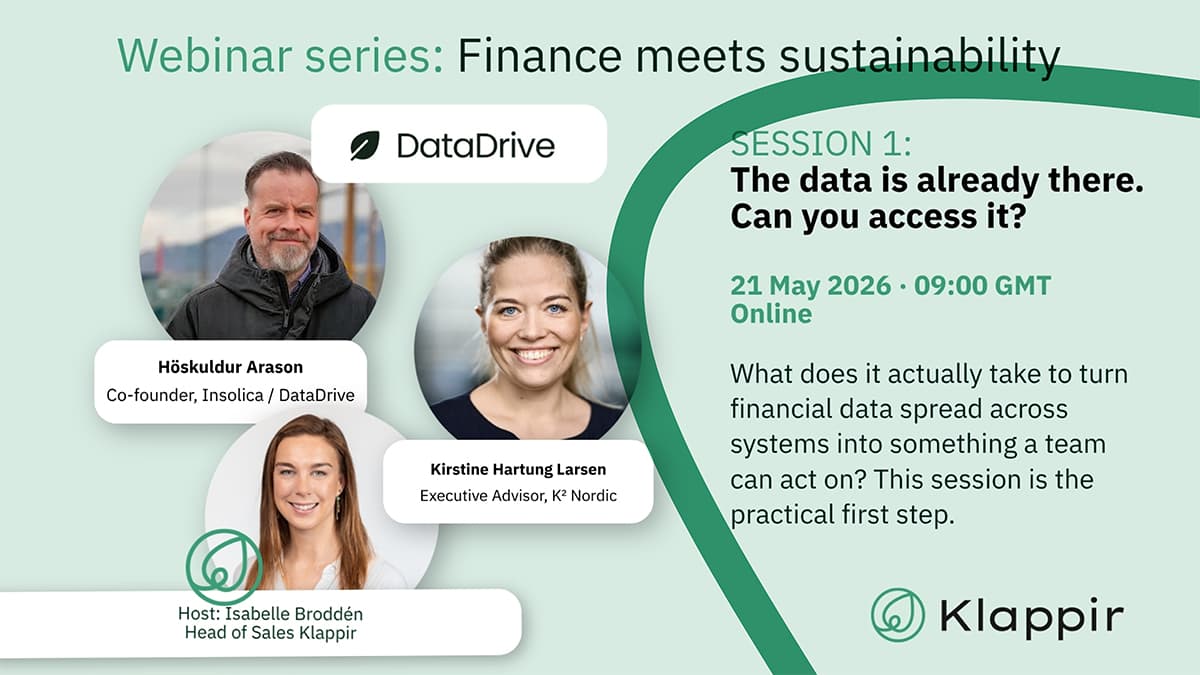
This is the work Session 1 walks through, with real examples from both sides. Kirstine Hartung Larsen (K² Nordic) brings the practitioner view. Höskuldur Arason (DataDrive) brings the data infrastructure view.
Session 1 is on 21 May at 09:00 GMT. It's 30 minutes. It's free. One registration enrols you in all three sessions in the series.
The data you already have is an operational resource. Structured once, it flows to your team, your clients, your auditors. All from the same foundation. Session 1 is where that work starts.
Webinar 1: The data is already there. Can you access it?
21 May, 2026, 09:00 GMT
How to find and structure financial and procurement data for sustainability use Where does the data you need actually live, and who controls it?
Before sustainability can share anything forward, someone needs to share it with you first. We look at how sustainability and finance teams can start working from the same sources, and what it takes to structure financial data so it becomes useful for sustainability decisions and strategy.
Webinar 2: What is the data actually telling you?
27 May, 2026, 09:00 GMT
Turning Scope 3 data into decisions
Once you have structured data, the next question is what to do with it. Using purchased goods and services as a concrete lens, we explore how to read the data, identify where your biggest impacts sit, and prioritise what to act on first.
Webinar 3: Stop pitching ESG. Start pitching investments.
4 June, 2026, 09:00 GMT
How to speak finance when it's time to get your projects funded
Every sustainability team has a proposal that didn't get funded, not because it was wrong, but because it was pitched in the wrong language. In 20 minutes, ESG Implementation shows you how to reframe your initiatives in the three ways finance actually responds to: revenue protection, risk reduction, and operational resilience.
All three recordings in one place, plus the e-book. Fill in the form below to get access. 👇
Klappir
Klappir Green Solutions
Klappir is a sustainability data platform that helps organizations measure, manage, and report their environmental impact.