Ölgerðin: A century of craftsmanship, a decade of auditable climate results
How Iceland's largest beverage producer built a sustainability data foundation that turns operational data into documented, verifiable results, and hit its science based target six years early.
Over a century of history. A decade of structured sustainability data.
Ölgerðin Egill Skallagrímsson is Iceland's largest beverage producer, with over a century of history and a portfolio spanning soft drinks, energy drinks, water, spirits and food. Since March 2026 Ölgerðin operates as the beverage company within Bera hf., the listed group that also includes Danól, Iceland Spring and Collab. The group reported revenues of 47.6 billion ISK and 427 full-time equivalents in its 2025 sustainability statement.
Sustainability at Ölgerðin is not a communications exercise. The company is a member of the UN Global Compact, a signatory to Festa's Climate Declaration, and set a science based target validated by the Science Based Targets initiative (SBTi): a 42% cut in Scope 1 and 2 emissions by 2030. That target was reached in 2024, six years ahead of schedule, and by the end of 2025 the reduction stood at 63%. In 2024 the company became the highest-scoring manufacturer in Iceland in the inaugural Sjálfbærniásinn sustainability index and holds an A3 rating in Reitun's ESG assessment.
None of this happened by accident. It happened because Ölgerðin chose to measure everything, and built the data foundation to make those measurements trustworthy.
Data without structure
When Ölgerðin first committed to sustainability in 2013, on its 100th anniversary, setting 100 goals for the future, the intent was clear. But intent isn’t enough without data you can trust.
The problem wasn’t a lack of ambition. It was a lack of structured data.
Operational data lived across invoices, spreadsheets, and disconnected supplier systems, with no common structure. Without a shared format, there was no reliable baseline, no way to track whether actions were working, and no path to external verification.
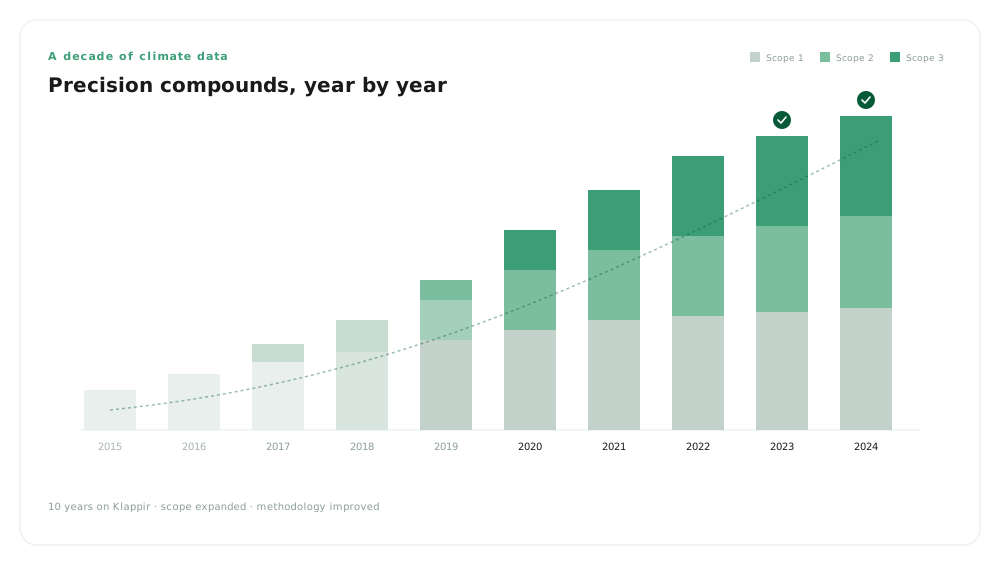
A single operational data foundation
Ölgerðin partnered with Klappir in 2017. The platform standardised how operational data, energy, fuel, waste, water, transport, is defined, structured, and stored across the business. Data flows in automatically from service providers and suppliers, tagged consistently at the transaction level, and held in a governed structure that doesn’t change when methodologies or regulations do.
The result is that the same data driving decisions on the production floor also underlies the annual sustainability statement and the independent assurance from PwC through 2024. Collected once, used everywhere, from engineer dashboards to auditor sign-off.
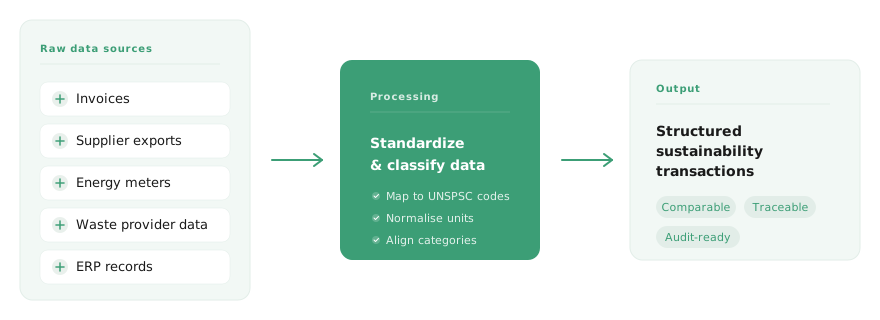
From raw data to assured results
Standardized data ingestion
Energy, fuel, waste, and water data flows in automatically from service providers and suppliers, tagged consistently at the transaction level.
Governed data structure
A governed data foundation that doesn’t change when methodologies or regulations do, so historical data stays reliable over time.
From operations to assurance
The same data that runs engineer dashboards carried the sustainability statement through independent assurance by PwC in 2024. One foundation, every use case.
The results
Documented, verifiable progress
Emissions
Reduction in Scope 1 & 2 emissions since 2020
Energy
Renewable energy share in 2025 (up from 86.8% in 2020)
Waste
Packaging & Community
“It’s easy to see how goals are progressing and whether tactics are working. The system is a godsend not only for us who do the environmental reporting but also for our machinists and engineers, who now have a comprehensive overview of the energy intensity of every single machine. This is a very practical tool, and it helps us manage resources in smart, sensible ways.”
The road to 2040
Ölgerðin’s 2040 carbon neutrality commitment covers the full value chain, a harder and more meaningful target than operational neutrality alone. The road ahead includes maximising recycled content in plastic bottles in line with material quality guidance, completing ISO 14001 certification with the stage 2 audit planned for 2026, 750 employee improvement projects in 2026, and extending the data foundation as the group grows, with the bakery companies Gæðabakstur and Kjarnavörur entering the sustainability statement from 2026.
Each of those goals depends on data that can be trusted at every point in the chain. That’s what the platform is built to provide.
Common questions
What teams most often ask about this story.
The platform standardises data from service providers and suppliers at the transaction level. Energy, fuel, waste, water, and transport data flows in automatically, tagged consistently so it can be compared across time periods and locations. The same data foundation powers both operational dashboards and the annual PwC-assured sustainability statement.
Yes. Ölgerðin’s 2024 sustainability statement received independent assurance from PwC. Every disclosed metric traces back to its source transaction through the platform, which provides the audit trail and traceability required for external verification.
The 57% reduction in Scope 1 and 2 emissions since 2020 reflects fleet electrification, energy efficiency improvements, and the shift toward renewable energy sources. The platform tracks these changes at the asset and transaction level, so the reduction is traceable and verifiable.
Have a different question?
Talk to our team about your organisation’s data infrastructure.
Ready to build your sustainability data foundation?
See how Klappir’s data infrastructure can give your organisation the same traceability and auditability Ölgerðin depends on.
No commitment. No sales deck. Just a conversation about your data.