
20%lower cost per kilo, ÞG Verk
Find what each kilo of waste costs
See weight and cost by waste type, site and period, from the data your waste company already holds. ÞG Verk followed its cost per kilo as its sorting ratio rose.
Waste monitoring →Connect your waste companies, and Klappir sorts the data by site and waste type, so you see what you pay and where to sort better.
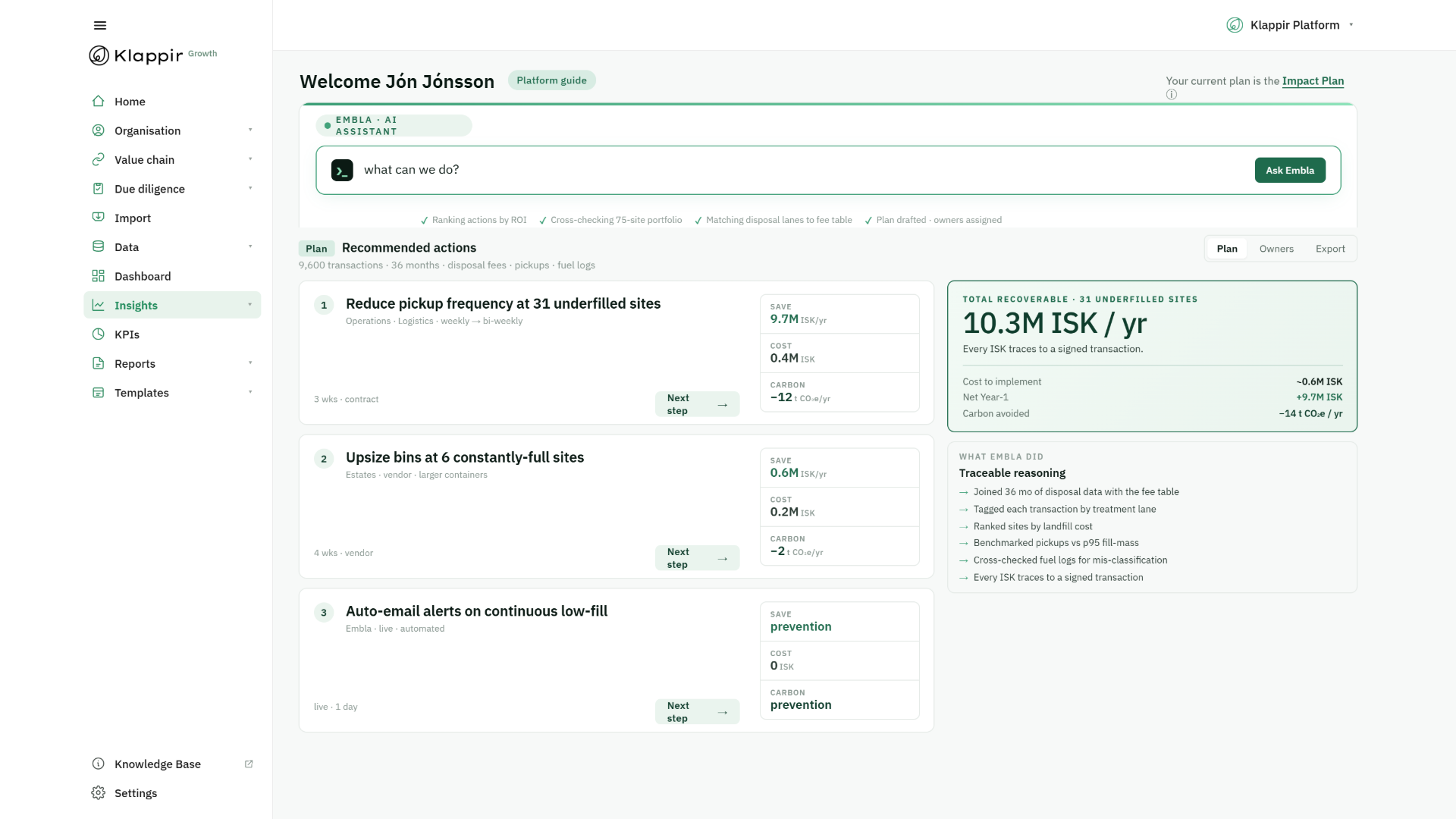




Your waste company weighs what it collects from you, down to the kilo. That data reaches you as invoices and portal exports, one site at a time, so the sorting ratio and the cost per kilo are rarely known until the year is over. Mixed waste usually costs more to handle than sorted waste, so without the figures the savings stay out of sight.
See weight and cost by waste type, site and period, from the data your waste company already holds. ÞG Verk followed its cost per kilo as its sorting ratio rose.
Waste monitoring →Track the sorting ratio for every site and see where mixed waste still goes in. Guldsmeden Hotels put sorting bins in every hallway once it saw its ratio.
Operational insights →The same waste records feed your climate accounts, certifications and customer requests. Íslandsbanki cut emissions from waste as its recycling rate rose from 59% to 70%.
Carbon accounting →Every record is classified to international standards and traceable to its source: the collection, the invoice or the file it came from. When your waste company is connected, its data arrives without anyone chasing it.
Waste data is collected once, from your waste companies, invoices and files. Every record is classified the same way by weight, waste type and site, with an audit trail back to its source.
When your waste company is in the ecosystem, it shares its collection data with you directly. You share the results onwards with a parent company, customers or an auditor, in the format they need.
Where are we losing money? See cost and weight per waste type, the sorting ratio for each site, and where mixed waste is still growing.
“The problem was that we did not know how much waste we were generating or how much was recycled... During this time, the waste sorting ratio at ÞG Verk has gone from 57% in 2018 to 83% in the first half of 2021 and the recycling rate of waste has gone from 33% to 77% over the same period... We have seen that we have a 20% lower cost per kilo this year than last year.”
Embla analyses your waste data and points to measurable cost savings, such as sites where mixed waste is growing. Embla suggests. You decide. Klappir Lab is in early access.
From your waste companies, your invoices and your own files. When a waste company is connected to Klappir as a data partner, its collection data arrives by site and waste type without anyone chasing it. Other waste data can come in as uploads in the platform, scheduled files over SFTP or through the API. Every route lands in the same structure, based on international standards.
Yes, where the weight and the cost are both in your data. Klappir holds the weight from the collection data and the cost from invoices against the same site and waste type, so you can follow the cost per kilo over time. ÞG Verk reports a 20% lower cost per kilo as its sorting ratio rose from 57% to 83%.
Yes. Waste data is tagged by site, asset and legal entity. You can compare sorting ratios between sites and see which ones to act on first. For a group, the data is consolidated without manual reconciliation.
Emissions from waste are calculated from the same records, built on the foundations of the GHG Protocol. Each result links back to the source transaction and the factor applied. The same data can support CSRD and ESRS disclosures, certifications and customer requests, without collecting it again.
Yes. Waste companies join the ecosystem for free and share their data with every customer who asks. Once a waste company is connected, its data reaches each of its customers in the format they need. If yours is not connected yet, our team can invite it.
The Core plan is free, with one free data connection included. Core gives you the platform and lets you share and receive data. Your suppliers and customers join Core for free too.
More than 4,500 organisations are in the ecosystem, built around 700+ customers in 26 countries. Core is free to join on both sides of the value chain, includes one free data connection, and is what you need to share and receive data.