
Arena Hotels & Suites: Green Key on all three properties
How a Rio de Janeiro group spent a year turning an environmental commitment into verified data, and came out with Green Key on all three properties.
An operational responsibility, taken literally.
For a group whose three hotels sit on the seafront at Leme, Copacabana and Ipanema, the natural beauty of Rio de Janeiro is not scenery. Arena Hotels & Suites treats it as an operational responsibility, and in April 2025 the group began a structured programme to turn that commitment into something verified and measurable rather than stated.
The group worked with HUBIS Consultoria, the Rio-based sustainability consultancy that guided the implementation, and deployed Klappir as the data layer underneath it. Roughly a year of preparation followed, during which procedures, indicators, internal policies and existing initiatives were assessed across all three properties. All three were then awarded Green Key, the international certification for environmental management in tourism, present in more than eighty countries and judged on environmental management, energy and water efficiency, impact reduction, environmental education and social responsibility.
Rio de Janeiro teaches us every day the value of an exuberant natural world. Winning the Green Key seal is our way of giving that beauty something back, in the certainty that regenerative tourism is not a trend, it is the only path.
Gabrielle Fontes, General Manager, Arena Leme
The practices were already there. The evidence was manual.
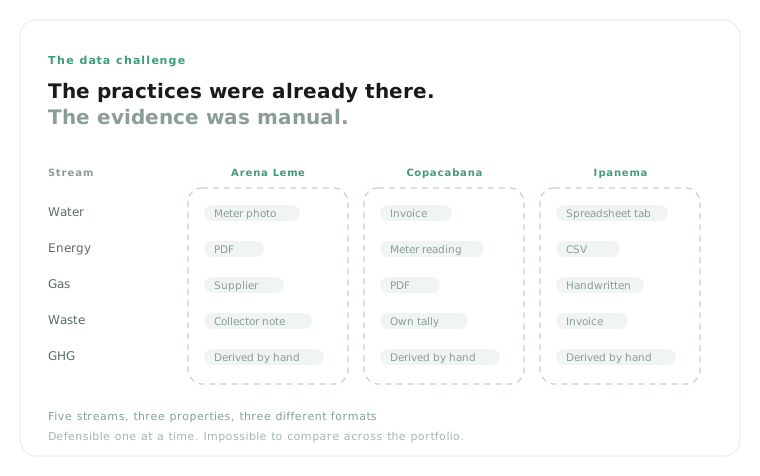
Environmental action was not new at Arena. It was part of how the properties already ran before certification was ever discussed. What certification demanded was different: not better intentions but an auditable record, assessed against rigorous and mandatory criteria across procedures, indicators and internal policies at three properties at once.
Manual data tracking falls short of the precision those frameworks require, and it falls short in a particular way. It produces figures that are defensible one at a time and impossible to compare across a portfolio. Three hotels are not one operation with three addresses. Each has its own building, its own occupancy pattern and its own suppliers, and each generates consumption data in its own place and its own format. To certify all three simultaneously, Arena needed environmental indicators mapped across the portfolio on the same definitions, kept current enough that an auditor could be shown a record rather than a reconstruction.
One centralised record, across three properties.
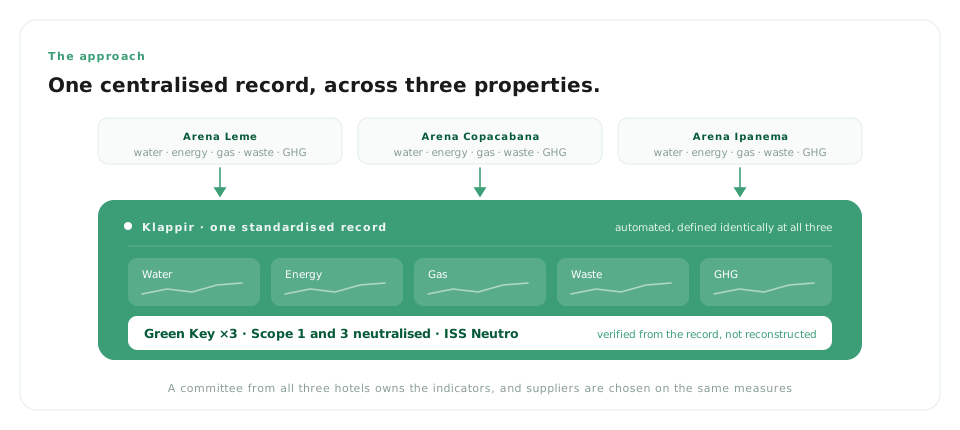
HUBIS provided the expert guidance and steered the implementation. Klappir provided the data infrastructure: a centralised, automated system ingesting water, energy, gas, waste and greenhouse gas data from across the group into a single standardised record.
Standardisation is what made the portfolio legible. Once consumption is defined identically at Leme, Copacabana and Ipanema, a gap between properties is a real difference in performance rather than an artefact of how someone recorded it.
Automation is what made it survivable. Gathering data from many operational points is the step that usually decides whether a programme like this outlives its first year, and it is the step that was simplified. Arena’s people were left tracking and evaluating the footprint rather than assembling it.
The rest was governance and habit. An internal sustainability committee, made up of representatives from all three hotels, took ownership of the indicators and follows their evolution. Every employee was trained in the practices behind them. The group also began choosing suppliers on their environmental practice, which extends the same logic outward: what you can measure, you can hold a supplier to.
The results
What the data shows.
Green Key on all three properties
Continuous monitoring changed what the compliance audits were. Instead of a search for evidence, verification became a review of a record that already existed. This is the least visible benefit of measuring continuously and often the one that saves the most time.
Scope 1 and Scope 3 mapped and fully neutralised
Direct operational emissions and supply chain and logistics emissions were both mapped across the group, then neutralised in full.
ISS Neutro secured
ISS Neutro is a municipal green tax incentive created by the city of Rio de Janeiro to support the voluntary carbon market. Qualifying requires an audited emissions inventory, and it was the data foundation that made the programme accessible to Arena. This is the point at which a standardised consumption record stops being a reporting convenience and becomes a condition of access.
Water flow down 20 percent, and more than R$ 1 million saved
Clearer visibility of emissions and consumption made reductions evident rather than assumed. Over twelve months, optimising the use of resources produced more than R$ 1 million in savings across the group, alongside a 20 percent reduction in water flow.
Beyond the numbers.
The group now runs 100 percent certified renewable electricity through I-RECs, water efficiency systems, LED lighting, low-consumption equipment and waste management on the Lixo Zero method. The Green Key plaques in the hotels have turned out to do work of their own, prompting guests to ask about the practices behind them.
When hotels on beaches as striking as Copacabana, Ipanema and Leme adopt structured environmental management, they show that quality in hospitality and sustainability can go together.
Fernanda Melo, National Coordinator, Green Key Brazil
“We believe the tourism of the future can no longer merely consume destinations; it must nurture them. With our ESG Program, the Arena Hotels & Suites network proves that the union of Klappir’s technology, data intelligence, and transparent corporate governance generates high-level hospitality that protects the environment, dignifies people, and drives business profitability.”

A routine, not a project.
Green Key marks a new stage in Arena’s ESG agenda rather than the end of one. The group has committed to continued investment in operational efficiency, to improving its environmental indicators, and to developing new ways of reducing impact.
The practical change is that the programme is now a routine rather than a project. With three properties reporting on the same standardised record, Arena can test a change at one hotel and know whether the result transfers to the other two, and the next certification cycle becomes a review of something already running.
Common questions
What teams most often ask about this story.
No. Arena achieved them, with HUBIS designing and steering the implementation. Klappir supplied the data infrastructure that made consumption visible and verifiable while there was still time to act on it.
Water, energy, gas, waste and greenhouse gas emissions across all three properties, standardised so the figures are comparable between them, covering Scope 1 and Scope 3.
A programme created by the city of Rio de Janeiro to support the voluntary carbon market. Companies paying municipal service tax in Rio that offset their emissions can receive municipal tax credits, and qualifying requires an audited emissions inventory.
About a year of preparation, during which procedures, indicators, internal policies and existing initiatives were assessed across all three properties.
Yes. Standardising consumption data across two properties works the same way as across twenty. The work is in the definitions, not the volume.
Have a different question?
Talk to our team about your organisation’s data infrastructure.
See what this looks like across your own properties
We’ll look at how your properties track water, energy, gas, waste and emissions today, and show you how one standardised record replaces three sets of spreadsheets.
No commitment. No sales deck. Just a conversation about your data.