
An additional pair of eyes on your sustainability statement
The Statement Programme takes your organisation from choosing a reporting framework and scope, through reviewing your data and closing gaps, to publishing an audit-ready sustainability statement. Work through it on your own with Klappir Academy, or with a dedicated mentor through Statement Mentorship.
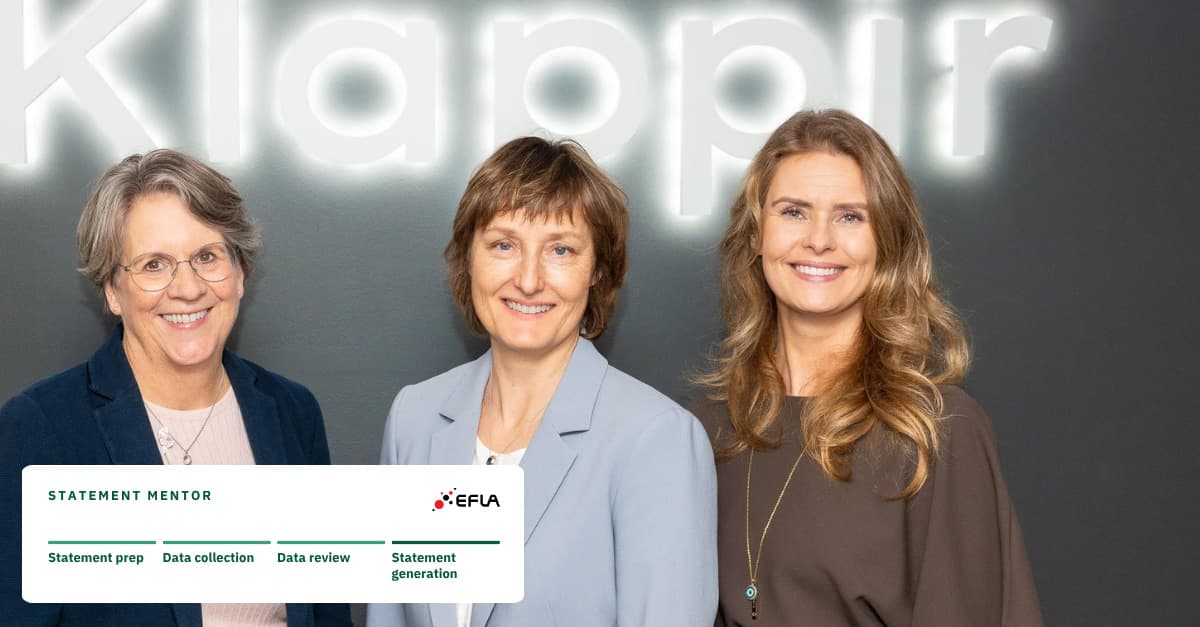
The Statement Programme helps organisations produce their sustainability statement in four phases, including a dedicated data review phase.
Klappir customers start the programme with the resource use data (activity data) they have already collected in the platform. That data is structured and classified as it comes in, so much of it is already ready for reporting.
Banks, investors, authorities and business customers ask for your measured resource use and emissions. Once structured and documented, your statement data can be shared with each of them without rebuilding it every time.
Four phases, from scope to statement
The programme draws on more than ten years of statement work at Klappir. The four phases are:
- Introduction and statement preparation: Set your scope and lay the foundation for data collection, with defined emission categories and your chosen reporting template.
- Statement data collection: Gather your environmental, social and governance data, with support to structure and classify it.
- Statement data review: Review and validate the collected data, and address remaining trends, gaps or variances.
- Statement generation: Produce your final, publish-ready statement.
The programme follows the reporting standard your organisation uses, including ESRS, VSME and Nasdaq ESG. You choose the standard in the preparation phase, so collection and review support it from the start.
Two ways to work through it
Organisations that want to run the process themselves can take the Statement Programme in Klappir Academy for free. Each phase has walkthroughs, practice exercises and quizzes.
Organisations that want an additional pair of eyes on their work can choose to work with a Statement Mentor. A dedicated Statement Mentor works alongside the team through every phase: helping you prepare and involve the right data owners, supporting data collection, reviewing data coverage and quality, challenging year-on-year changes, and helping shape the final statement's notes and wording.
Across the sessions, support and mentorship are designed to build confidence in your reporting decisions, support data collection, and strengthen internal ownership. Preparing the team to be better prepared for the next reporting cycle.
Data quality control before you publish
Statement Mentorship includes a hands-on review of your data with your mentor before anything is published. It covers:
- Completeness and consistency of your data
- How your numbers were calculated, including the assumptions behind them
- Gaps in data coverage that could affect the credibility of the statement
- Where your data stands against the metrics in your chosen reporting template
The full audit trail in the Klappir platform backs everything, recording every data point, source, and piece of supporting evidence. Klappir manages the emission factors and coefficients, so your mentor works from a documented, consistent methodology.
For Eik, working with a Statement Mentor gave room to develop and complete the report.
“In cooperation with Klappir's statement mentor EFLA… we expanded our sustainability reporting to include estimates of the embodied carbon within Eik's property portfolio. A genuinely valuable addition.”
Guðrún Álfheiður Thorarensen, Specialist, Business Development and Sustainability, Eik
Who the programme is for
The Statement Programme works well for organisations that are preparing to answer data requests from banks, investors or customers, need to stand behind their numbers in front of boards, lenders or insurers, report under ESRS, VSME or Nasdaq ESG or are preparing to, or want a baseline to measure progress against and base resource decisions on.
Start early in your reporting year.
When you start shapes what the review phase looks like. You can fill a gap early at the source, whether it is a missing meter reading or a supplier who hasn't sent figures yet. Gaps found close to the deadline usually get filled with estimates. Starting early is the difference between a statement built on recorded data and one built on assumptions.
Compare both routes on the Statement page.
Klappir
Klappir Green Solutions
Klappir is a sustainability data platform that helps organizations measure, manage, and report their environmental impact.